
Nigerian Traditional Engagement Photographer
Los Angeles, Orange County and across Southern California. The letter, the prostration, the outing of the bride and the gele that took an hour to tie — photographed the way your family will want to remember it.
The ceremony that makes the marriage
In most Nigerian families the traditional engagement is not the warm-up act. It is the wedding. The white wedding that follows — the next day, the next week, sometimes the next continent — belongs to the church. The engagement belongs to the families. It is where the two houses meet in front of everyone, where the letter is read out loud, where the bride price is presented, and where the moment the bride is brought out and seated beside him, the room considers them married.
It is also, quietly, the harder of the two days to photograph. A white wedding runs on a printed timeline. An engagement runs on a script nobody hands you, moderated by two women with microphones who are improvising, and the best frames arrive inside jokes told in Yoruba that the photographer has to read from the room rather than the words. You cannot cover it well by reacting. You cover it well by knowing what is coming next.
I have been photographing Nigerian celebrations in Southern California long enough to know the order, to know which side of the canopy the Alaga Ijoko will pull the groom toward, and to be already low and already close when he goes down on the mat.
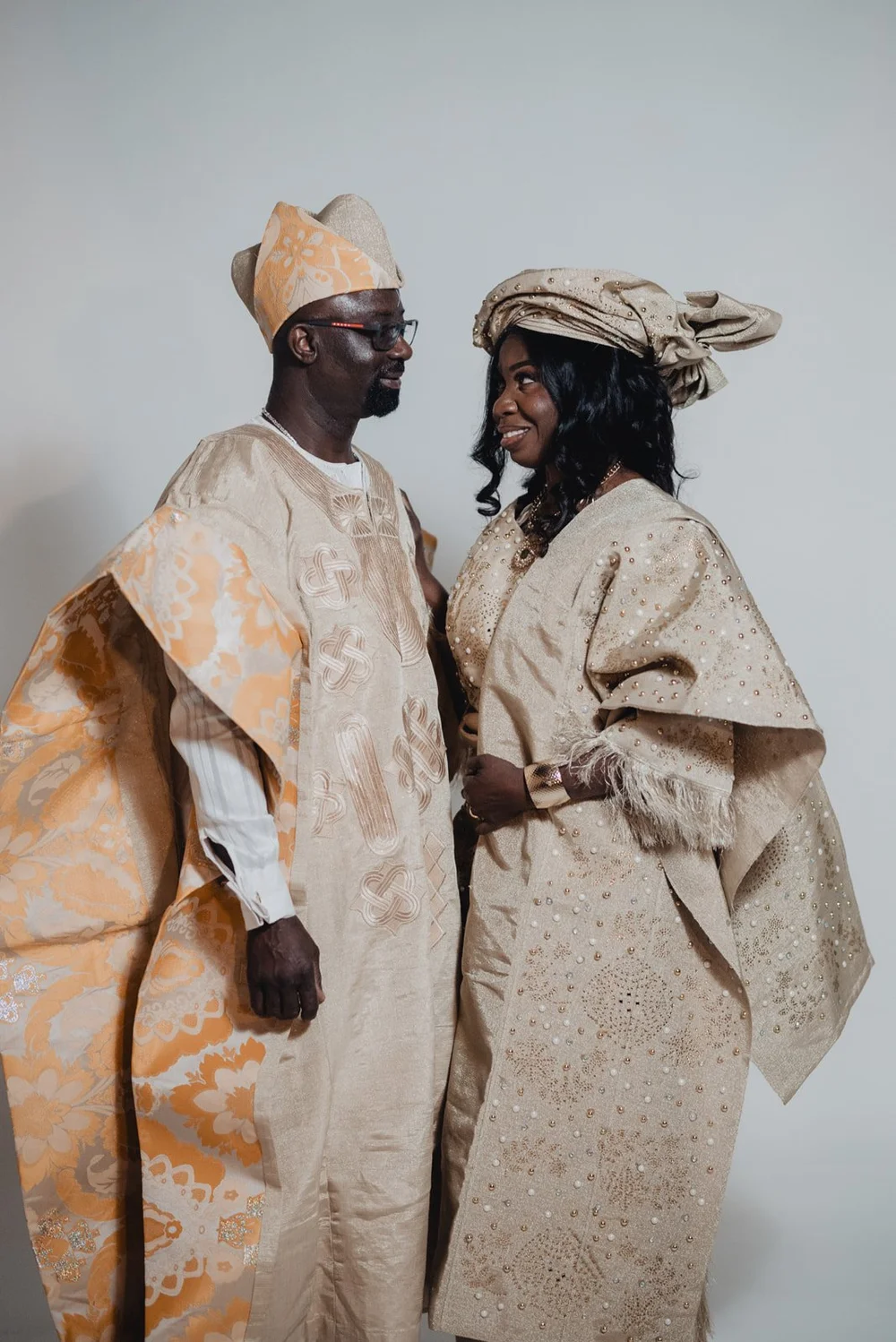
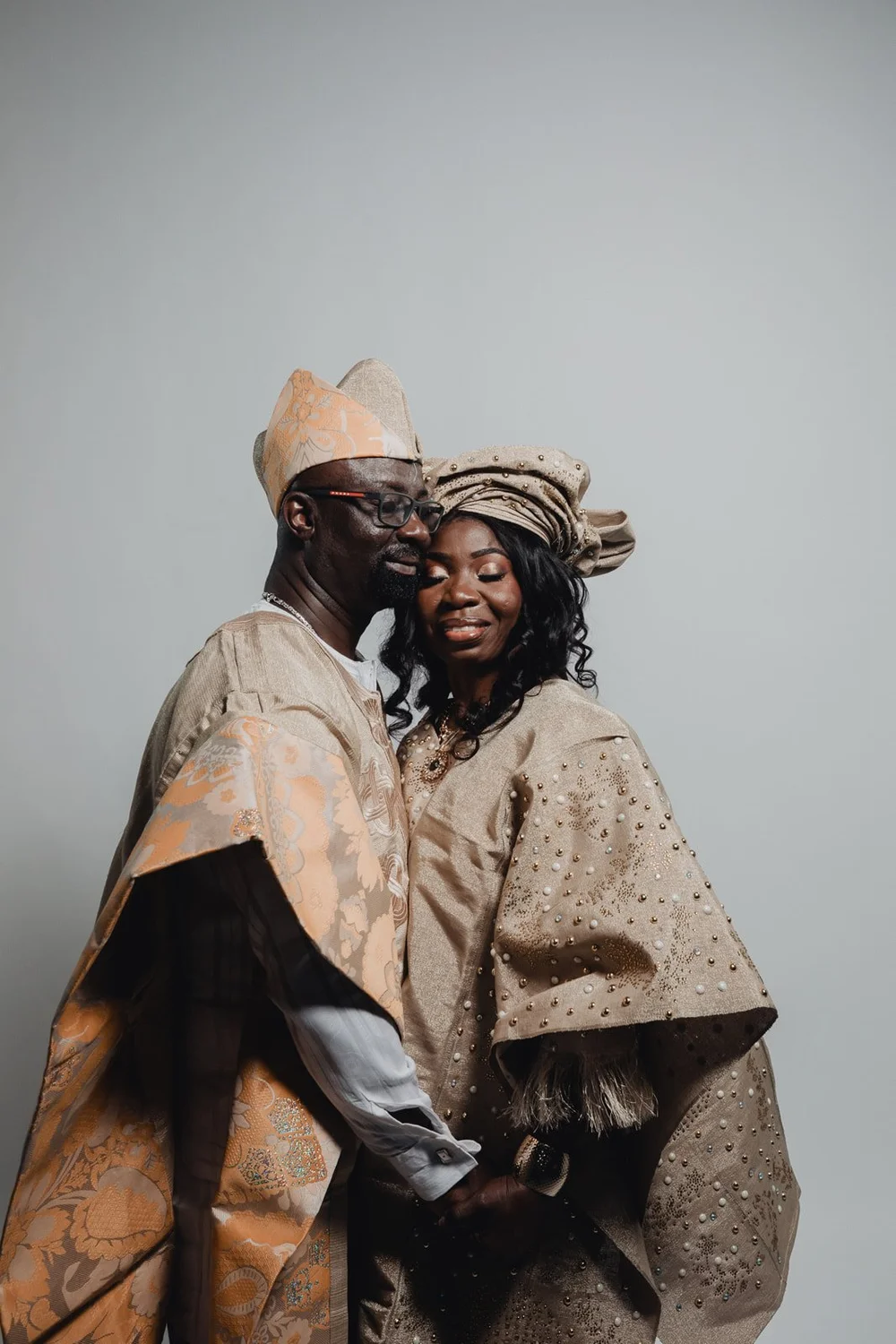
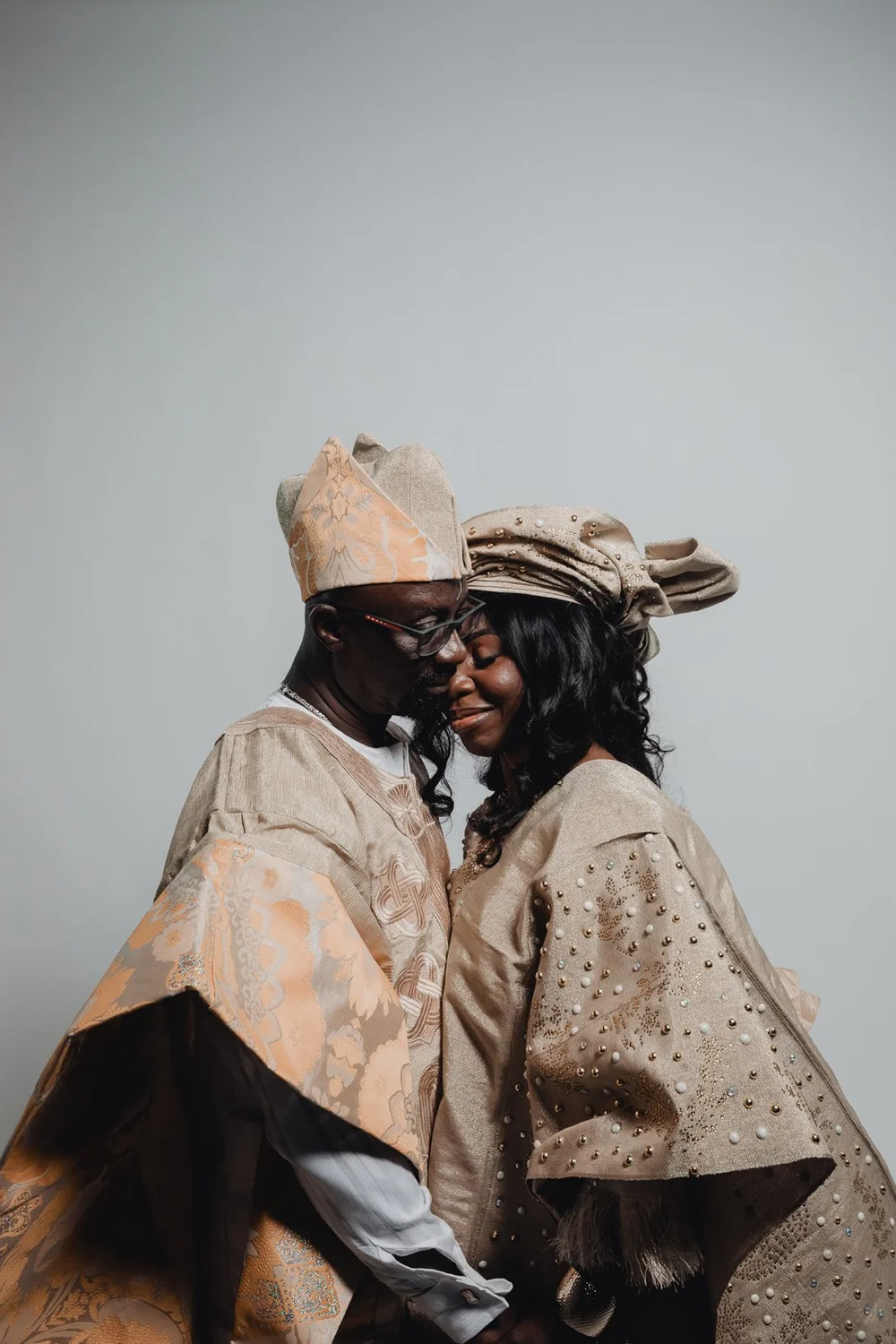
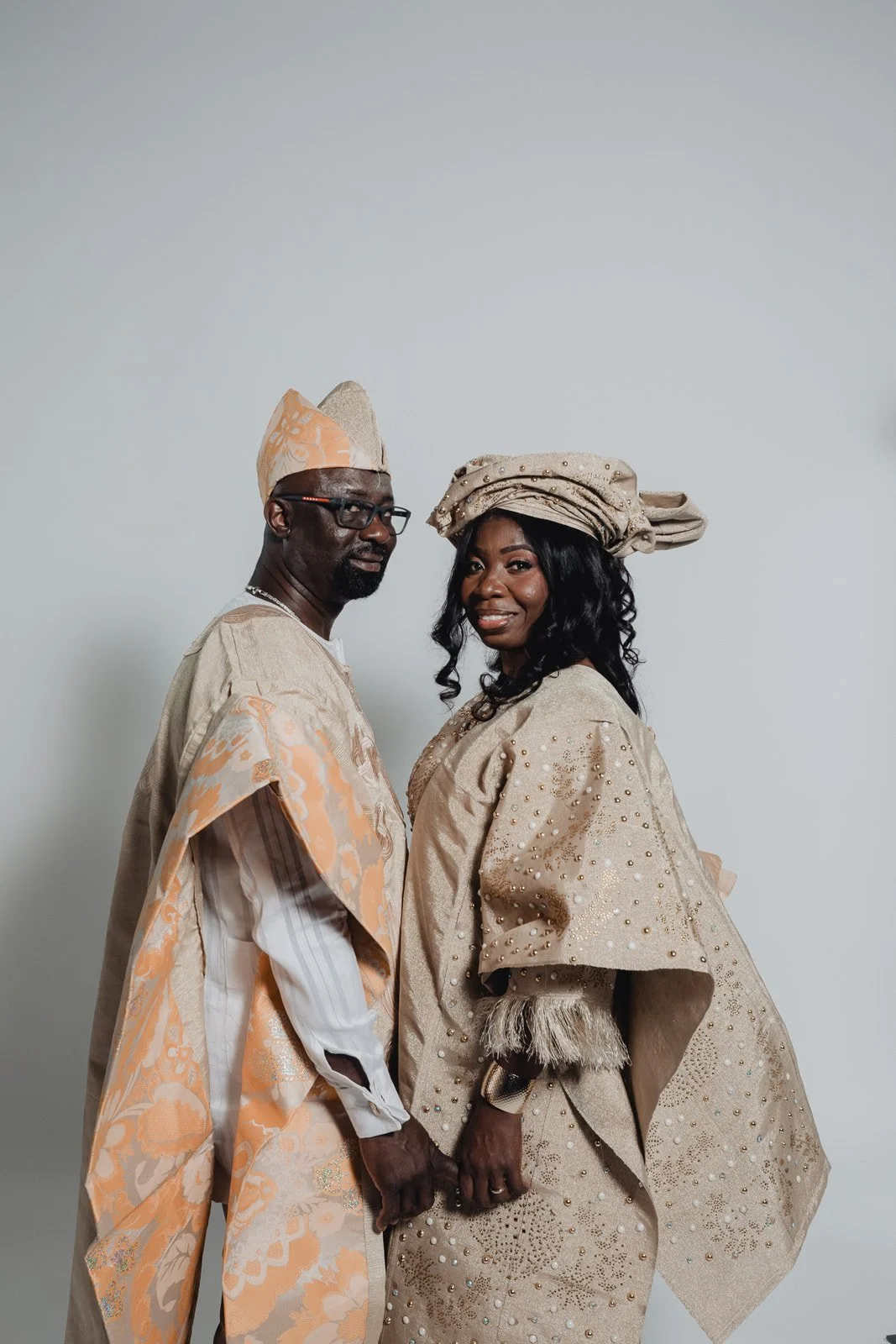
Aso ebi chosen together and worn together — the couple in matching cream and peach.
How the engagement actually runs
Two Alaga — professional female masters of ceremony — run the day between them. The groom’s family hires the Alaga Iduro, who stands and speaks for his side. The bride’s family hires the Alaga Ijoko, who sits, guards her family’s interests, and makes the groom work for every step. The comedy between them is the entertainment; the talking drum punctuates it.
Opening prayer
An elder or clergyman opens. The room is still for the only time all afternoon — worth a wide frame of both families seated opposite each other.
The Alagas take the floor
Introductions, praise-singing, and the first round of teasing. The groom’s party is kept waiting at the edge on purpose.
The proposal letter
A letter from the groom’s family asking for the bride is submitted and read aloud, usually by a young woman from the bride’s side. Many families answer it with an acceptance letter.
Dobalẹ̀ — the prostration
The groom and his friends go flat to the ground before her parents. It is done twice, three times, however many times the Alaga Ijoko decides is sincere.
The bride price and gifts
Trays are brought in and inspected out loud — yam, kola nut, salt, honey, fabric, suitcases. The counting is theater, and it photographs beautifully.
The outing of the bride
She is danced in under a canopy of aso ebi, surrounded by her friends, face covered. This is the single most important frame of the day.
Consent, and the seat
She kneels to her parents, confirms she knows him, and is seated beside him. At that moment, culturally, they are married.
The rings
Exchanged in front of everyone, followed by kneeling for prayers and blessings from both sets of parents.
Cake, feeding, spraying
The cake is cut, the couple feed each other, and the money starts falling. From here the afternoon belongs to the dancefloor.
Every family runs it slightly differently, and every Alaga has her own additions. Treat this as the spine, not the script — and send me your family’s order of events if you have one, because I will build the coverage plan around it.
Igba nkwu — the wine carrying
An Igbo traditional marriage arrives at the same place by a different road, and it is built in stages rather than in one afternoon.
Iku aka — knocking on the door
The groom’s father or an elder leads a small party to the bride’s family to state their intentions. Kola nut — ọjị — is presented, blessed and broken by an elder to welcome them. It is a short, formal, often very small gathering, and couples routinely decide not to photograph it. I would gently argue for at least an hour of coverage: it is the only day the two fathers meet as strangers.
Ime ego — the bride price
The agreed bride price and customary gifts are presented. The negotiation itself is usually private and closed to cameras; what is photographable is the presentation, the list being read, and the umunna nodding.
Ihe umunna — meeting the extended family
Before the main ceremony the groom’s people sit with the bride’s extended family to talk compatibility and histories. Photographically this is a room of elders and it is where the portraits of grandparents get made, because everyone is dressed and nobody is dancing yet.
Igba nkwu nwanyi
The centrepiece. The bride is given a cup of palm wine and sent to find her groom, who is hidden among the guests; the guests try to distract her, and her father’s friends will offer money to tempt her away. When she finds him she kneels and offers the cup, he drinks it, and the marriage is made. This is a two-photographer moment — one travelling with her, one already at him — and it is the one part of the day I would always add a second shooter for.
What I am watching for
The gele, before it moves
An hour of work goes into that headwrap and it is at its sharpest in the twenty minutes before she walks out. I photograph her seated, in window light, before the room fills — pleats, beadwork, the edge of the ipele on her shoulder. After the dancing starts it will never look like that again.
The prostration, from the floor
Shot standing, dobalẹ̀ is a man lying down. Shot from the mat at his eye level, with her parents in the frame above him, it is the picture of the whole ceremony. It happens fast and it does not repeat on request, so I am in position before the Alaga finishes the sentence.
The two families, opposite each other
The seating is the story: his side, her side, the aisle between them, and the slow collapse of that line over three hours. I make the same wide frame at the opening prayer and again at the cake, because the difference between them is the point of the day.
Money spraying without a flash in your face
Spraying is chaos, low light and flying paper. I work it with a single off-camera light held wide and a shutter fast enough to freeze a note mid-air, from outside the circle rather than inside it. You should be able to dance without negotiating with a photographer.
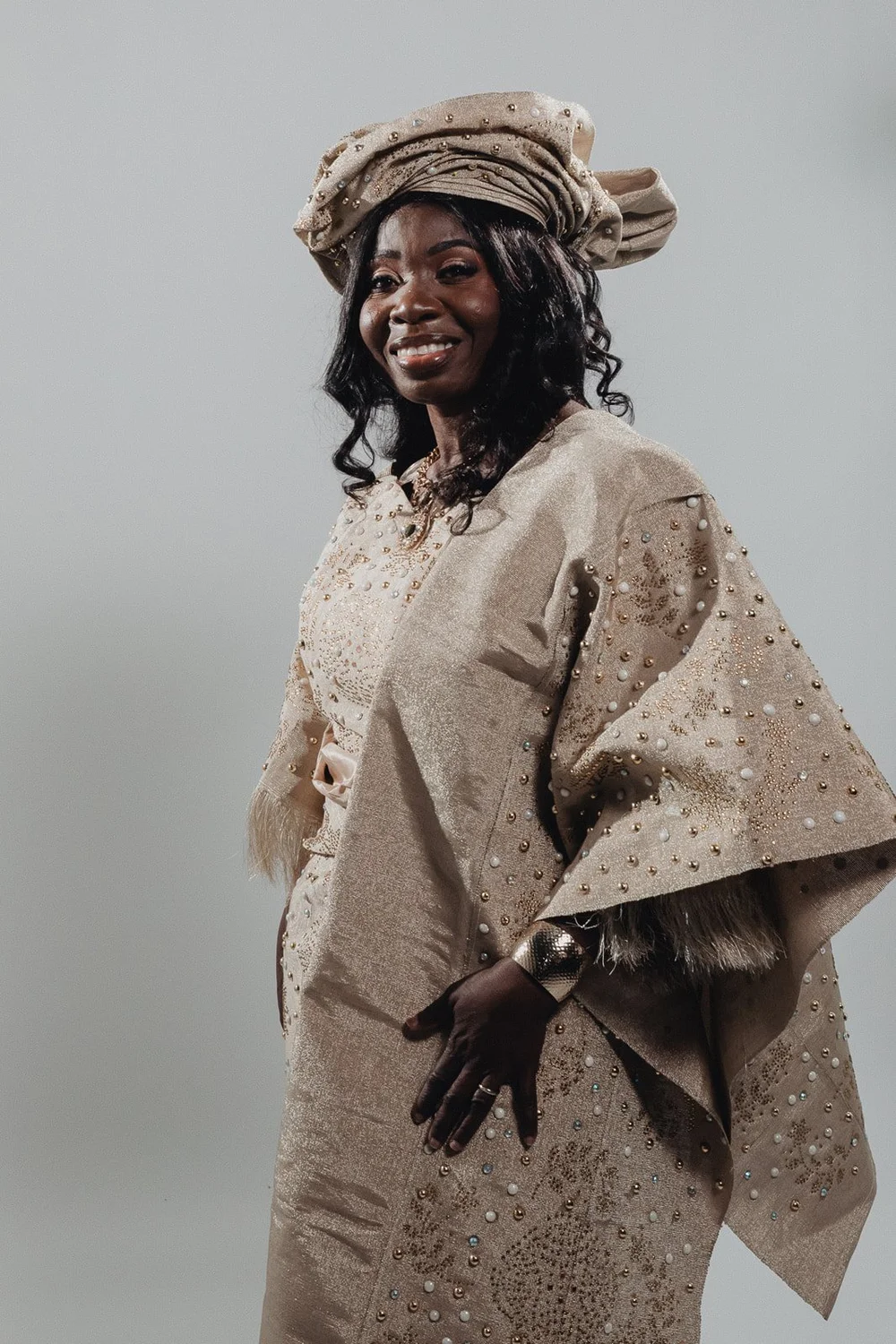
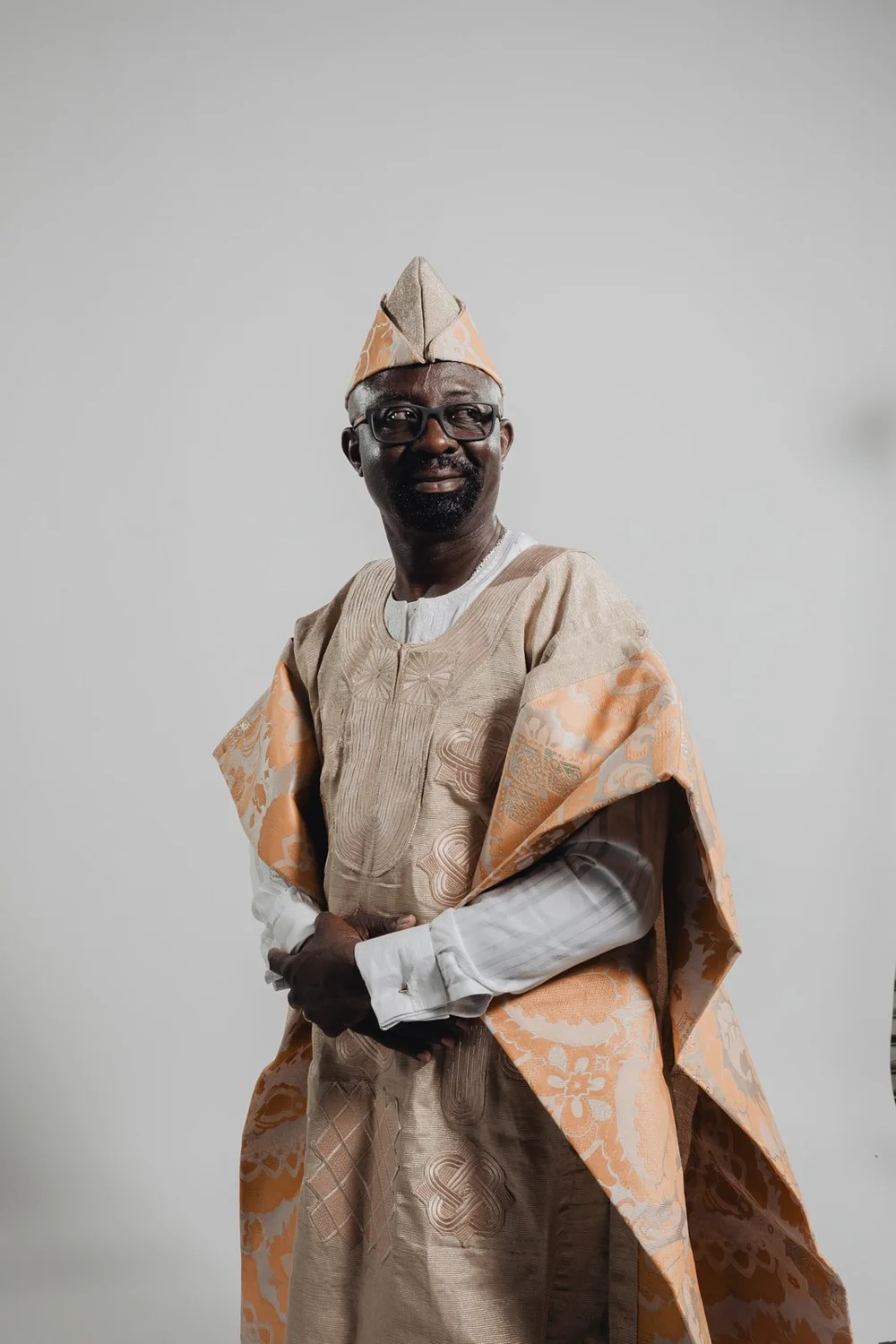
Portraits against seamless grey, where the beadwork and the fabric get to be the subject.
How the two celebrations fit together
Most of these weddings are two events: a traditional celebration on one day and a church ceremony with a Western reception on another. Each has its own guest list, its own attire and its own hours.
Two days, traditional then church
- Day 1, 5:00 PMCoverage begins. Attire, family arrivals, decor and the hall.
- Day 1, 6:00 PMTraditional reception begins. Entrances, the presentation, the family exchanges.
- Day 1, 7:00 PMDinner and the party.
- Day 1, 10:00 PMCoverage concludes.
- Day 2, 3:00 PMChurch ceremony.
- Day 2, 4:30 PMCocktail hour and family photographs.
- Day 2, 6:00 PMReception at the hotel.
- Day 2, 9:00 PMDancing and celebration, then coverage concludes.
Eight hours, one venue
- 1:00 PMCoverage begins. Getting ready and a first look.
- 3:00 PMTravel to the venue.
- 4:00 PMCeremony.
- 4:30 PMCocktail hour with family and group photographs.
- 5:30 PMReception. Entrance, dinner, speeches, then the dance floor.
- 9:00 PMCoverage concludes.
Six hours with a portrait block
- 2:00 PMCoverage begins. Getting ready at a hotel or in the hall itself.
- 4:00 PMA dedicated portrait session, often booked as its own two-hour block.
- 5:00 PMCeremony in the hall, with the area cordoned off from the reception setup.
- 6:00 PMRoom reconfigured. Reception details photographed during the turn.
- 6:30 PMReception, dinner and dancing.
- 10:00 PMCoverage concludes.
What shapes the timeline
The decisions that most often change the hours and the team, from the weddings we photograph.
Where these weddings happen
Halls, hotels and venues that recur across the Nigerian weddings we photograph.
- Top of the Hub
- Vertigo Event Venue
- Sheraton Park Anaheim Resort
- Los Angeles Athletic Club
- The Oviatt Penthouse
- Neighborhood Church
- Los Angeles banquet halls
- Downtown hotels for prep
Before you book
Is the traditional engagement the same thing as the white wedding?
No. The engagement is the traditional ceremony between the two families, and in most Nigerian households it is the one that makes the marriage. The white wedding is the church or civil ceremony. Many couples in Los Angeles hold them on consecutive days, some on the same day, and a few hold the engagement in Nigeria and the white wedding here.
How long does a Nigerian traditional engagement take?
Plan for four to six hours from the opening prayer to the dancefloor, and add ninety minutes before it for getting ready and the gele. The ceremony itself is usually ninety minutes to two hours; the reception that grows out of it is the rest.
Do you cover both days?
Yes, and I would encourage it. Two-day coverage is the most common booking I take for Nigerian weddings, and photographing the engagement first means that by the white wedding I already know your parents, your aunties, and which uncle will be dancing hardest.
What do you need from us beforehand?
Your family’s order of events if one exists, the names of your Alagas, a short list of family members who must be photographed, and a warning about anything that is not to be photographed. I would also like to know whether the engagement is Yoruba, Igbo, Hausa, Efik, Edo or a blend of two families’ traditions, because the coverage plan changes.
Can you photograph the money spraying without blinding everyone?
That is the goal. I work spraying from outside the circle with one light held wide, not a flash pointed at the couple from arm’s length. You get frames with notes suspended in the air and nobody gets a strobe in the eye mid-dance.
Do you travel outside Los Angeles?
Yes. Most of the Nigerian celebrations I photograph are in Los Angeles, Orange County and the Inland Empire, but I travel through California and out of state regularly, and destination coverage is quoted with travel included rather than added on afterwards.
Related coverage
Tell me about your two families
Send me the date, the venue and whose traditions you are honouring. I will come back with a coverage plan built around your order of events, not a generic package.