
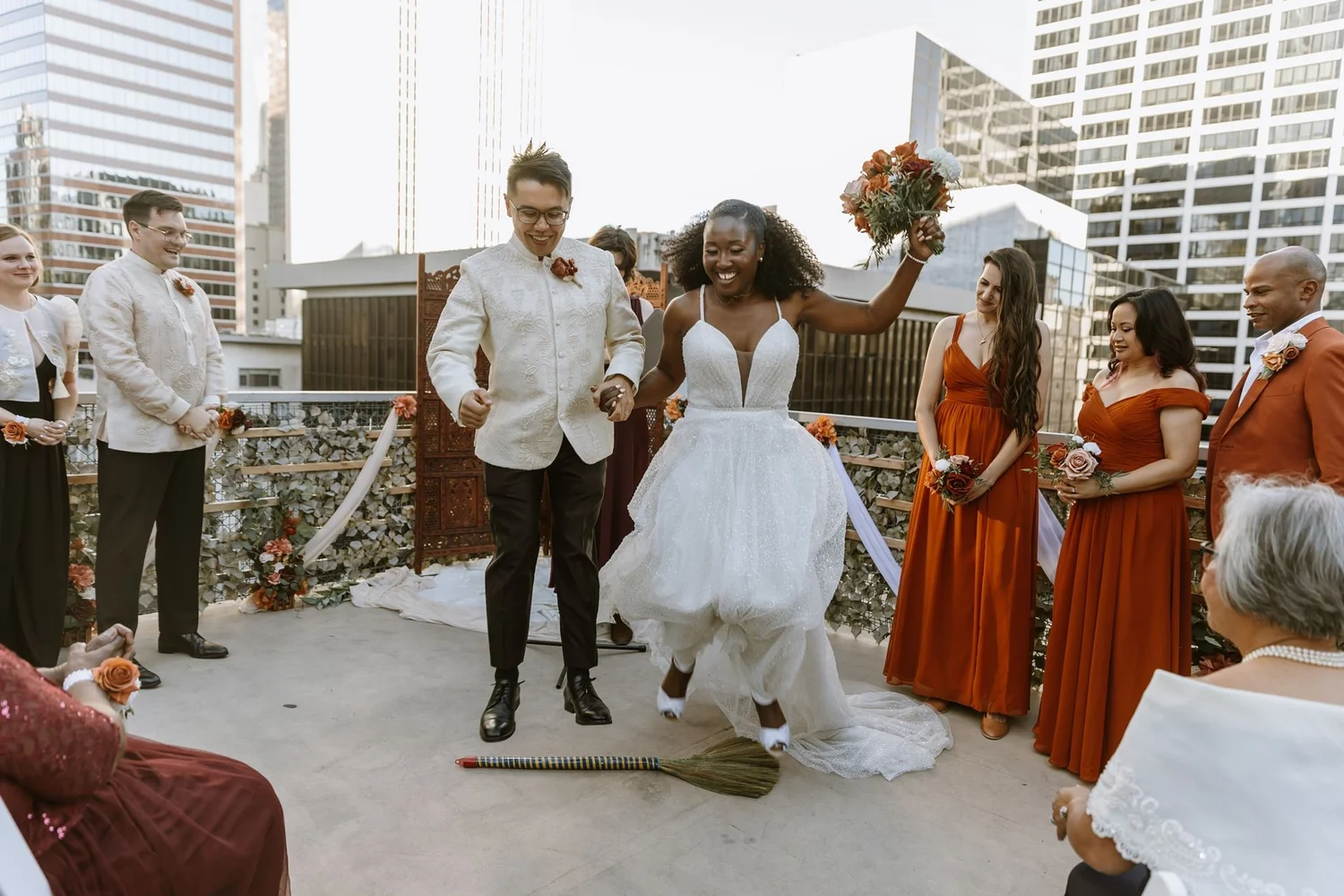
Nigerian wedding traditions · Los Angeles
Nigerian Wedding Traditions
and Photography in Los Angeles
The introduction, the white wedding, the reception — often across separate days, each with its own attire and its own guest list.
An introduction
Nigerian weddings in Los Angeles
2,300+ weddings photographed · 35+ national awards · 382 five-star reviews — Cinematic on Film
Nigeria is home to more than 250 ethnic groups — Yoruba, Igbo, Hausa and many others — each with its own wedding customs. There is no single template for a Nigerian wedding. What many share is vibrant coordinated family attire, sustained dancing, and a celebration that stretches across more than one event.
The thing that most often catches vendors out is that a Nigerian wedding is rarely a single day. Many couples hold a traditional ceremony, often called the introduction, separately from a white or church wedding, and then a reception — sometimes across two or three days. Each has its own attire, customs and guest list, which changes what photography coverage actually needs to be.
Coverage Built Around More Than One Event
Booking a Nigerian wedding as a single eight-hour day is the most common planning mistake we see. We scope coverage by event rather than by day.
- The introduction / traditional ceremony. Family-led, colour-coordinated, and often the most visually striking of the events. Frequently held at a family home or a hall rather than a venue.
- Aso ebi. Coordinated family fabric is the defining image of the day — we photograph the groups deliberately rather than hoping to catch them.
- The white wedding. Church ceremony, with the parish’s own rules about position and flash.
- The reception. Long, loud and late, with spraying, dancing and a programme that rarely runs to schedule.
Where events fall on different days we plan the team per event, so you are not paying for a photographer to sit through gaps.
Colour, Fabric and Skin Tone
Nigerian weddings are the most colour-saturated weddings we photograph, and colour is exactly where cheap coverage falls apart. Gele and aso ebi fabrics are deeply pigmented; reception uplighting is usually strong; and skin tones across a large family span a wide range in the same frame.
We meter and grade for skin first and fabric second, and we light the dance floor ourselves rather than working under whatever colour the DJ has running. That is the difference between a gallery where the fabric sings and one where everyone looks orange.
How Nigerian wedding days usually run
Two day shapes come up most often in the Nigerian weddings we photograph in Los Angeles and Orange County: getting ready at a hotel with the ceremony and reception elsewhere, or the whole day under one roof. Both are composites, a starting point to adapt with your planner.
Hotel, ceremony, then a long reception
- 12:30 PMCoverage begins at the hotel. Attire, jewelry, gele and details, then final touches with the wedding party.
- 2:00 PMFirst look and wedding party portraits, for couples who choose one.
- 3:00 PMTravel to the church or ceremony venue.
- 3:30 PMCeremony, thirty minutes to an hour depending on the church or officiant.
- 4:30 PMCocktail hour. Family groups in coordinated attire, photographed deliberately while everyone is together.
- 6:00 PMGrand entrance, first dance and parent dances.
- 6:30 PMDinner, speeches and cake cutting.
- 7:30 PMOpen dancing and spraying, covered as a sequence with our own lighting.
- 9:00 PMCoverage concludes, with the party often running later.
Everything under one roof
- 2:45 PMCoverage begins with the last hour of getting ready, on site or at a hotel nearby.
- 3:30 PMA moment of prayer with the wedding party before the ceremony, if the couple wants one.
- 3:45 PMCeremony in a section of the room, which is then opened up for the reception.
- 4:45 PMFamily and wedding party portraits while the space is reset.
- 6:00 PMGrand entrance with a dance entrance by the couple and wedding party, then the first dance.
- 7:00 PMDinner. Guests are called table by table to the sweetheart table for photos.
- 7:45 PMDancing. One photographer stays on the high table, another on the guests and the floor.
- 8:45 PMCoverage concludes after six hours.
What shapes a Nigerian wedding timeline
The planning details that change coverage most, from the Nigerian weddings we photograph.
Where these weddings happen
Hotels, halls and rooftops that come up on the Nigerian wedding days we photograph.
- Top of the Hub, Downtown Los Angeles
- Los Angeles Athletic Club
- Sheraton Park Anaheim Resort
- Churches near Anaheim hotels
- Kalaydjian Banquet Hall, North Hollywood
- The Vertigo, Glendale
- Hotels in Universal City
Nigerian wedding photography — questions we are asked
Can you cover the introduction and the white wedding on different days?
Yes, and we price it by event rather than as one continuous booking. Tell us how many events there are and where, and we will scope the team for each rather than stretching one day’s coverage across three.
Do you understand the different traditions?
We ask, rather than assume. Yoruba, Igbo and Hausa ceremonies differ substantially, and families within each celebrate differently again. Before the day we go through the running order with you so we know what is happening and who matters in each moment.
How do you handle the spraying and the dance floor?
As a sequence, with our own lighting. Spraying is continuous rather than a single moment, so we work the floor for the whole of it and make sure the elders and the parents are photographed as well as the couple.
Do you photograph other cultural weddings?
Yes — see our multicultural wedding guide, and our guides to Filipino, Chinese and Jewish weddings.
Next step
Tell us about your events
Send us the dates, how many events there are and where each one is — and we will scope coverage properly rather than guessing.