
Korean wedding traditions · Los Angeles
Korean Wedding Traditions
and Photography in Los Angeles
The paebaek, the hanbok portraits, the deep bows and the jujube toss — and how a Korean wedding day fits a Western ceremony and reception around them.
An introduction
Korean weddings in Los Angeles
2,300+ weddings photographed · 35+ national awards · 382 five-star reviews — Cinematic on Film
Los Angeles is home to the largest Korean community outside of Korea, and its weddings blend two worlds in a single day — a Western ceremony and reception woven together with the paebaek, hanbok, and family traditions that carry generations of meaning. Lulan Studio photographs Korean weddings across LA and Koreatown with photographers who know each ritual, so no bow, date-throw, or piggyback ride gets missed.
The Paebaek Ceremony, Photographed Properly
The paebaek is the emotional heart of a Korean wedding day — and the easiest part for an unprepared photographer to get wrong. Our coverage plan (for what each ritual means, see our full paebaek ceremony guide):
- The deep bows (keunjeol). We position for both the couple's form and the parents' faces — the reactions are the photograph.
- Jujube and chestnut toss. The couple catching dates and chestnuts in the bride's skirt is the frame every family asks for — we shoot it from the parents' side, wide enough to catch the laughter.
- The piggyback ride. The groom carrying the bride (and often his mother) around the table ends the ceremony on a laugh — we keep a clean background ready for it.
- Details first. The wedding ducks, silk screen, tea set, and food tower are heirloom-level details — photographed before the family enters.
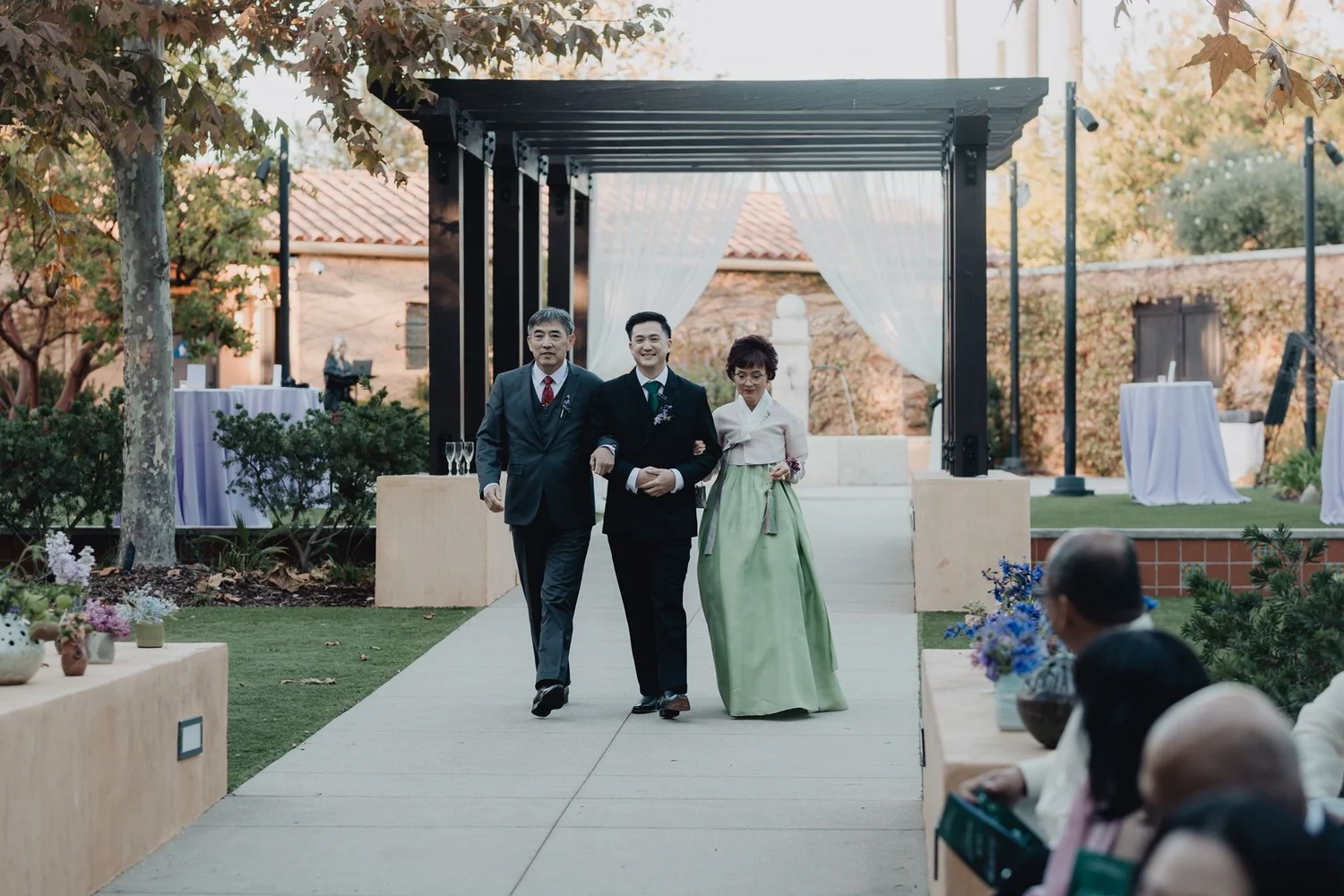
Korean wedding photographed by Lulan Studio in Los Angeles.
Hanbok Portraits Worth Framing
The hanbok's colors — deep reds, jade greens, royal blues — photograph unlike anything in Western wedding fashion. We schedule 15–20 minutes of dedicated hanbok portraits: couple, each family, and three generations together. If you are changing between a Western gown and hanbok, we build the changeover into the timeline so neither look feels rushed.
A Timeline That Honors Both Halves
Most LA Korean weddings run a Western ceremony and reception with the paebaek in between — usually during cocktail hour in a private room:
- 2:00 PM — Getting ready (gown first), details, letters.
- 3:30 PM — First look and couple portraits.
- 5:00 PM — Western ceremony.
- 5:45 PM — Change into hanbok; family gathers for the paebaek.
- 6:00 PM — Paebaek ceremony (30–45 minutes) while guests enjoy cocktail hour.
- 6:45 PM — Hanbok family portraits, then change back for the reception entrance.
- 7:15 PM — Reception — toasts, dancing, and often a noraebang-worthy dance floor.
Five Tips from Photographing Korean Weddings
- Give the paebaek 45 minutes. Rushed bows photograph like obligation; unhurried ones photograph like love.
- Assign a paebaek coordinator. An aunt or family friend who knows the ritual order keeps the room calm and the photos clean.
- Window light beats ballroom light. If your venue offers a room with natural light for the paebaek, take it.
- Brief us on family names and order. We photograph each set of parents and grandparents in the bowing sequence — a name list guarantees nobody is missed.
- Keep the hanbok on for portraits. The 15 minutes after the paebaek, while everyone is still dressed, is a portrait opportunity that never comes back.
Korean Wedding Photography FAQ
Do you know the paebaek ceremony? Yes — we have photographed it many times and plan positions for each ritual moment in advance, from the first bow to the piggyback ride.
Can you photograph the paebaek and cocktail hour at the same time? Yes — with multiple photographers, one team stays with the family ceremony while another covers your guests.
How much time should we set aside for hanbok portraits? 15–20 minutes right after the paebaek, while both families are dressed and together — we build it into your timeline.
Do you photograph Korean-fusion weddings where only part of the day is traditional? Most LA Korean weddings are exactly that — a Western ceremony with the paebaek woven in. It is our most common format.
Does paebaek coverage cost extra? No — it is part of your wedding-day coverage hours in every collection.
How Korean wedding timelines are usually built
Many of the Korean weddings we photograph pair a Western ceremony with a paebaek or tea ceremony, and others bring Korean elements into the ceremony itself. Where those moments sit in the day is the main decision.
Western ceremony, Korean ceremony during the reception
- 2:30 PMCoverage begins. Venue details before guests arrive, then getting ready.
- 3:15 PMFirst look, pre-ceremony portraits and family photographs.
- 4:30 PMHideaway, ceremony details and guest arrivals.
- 5:00 PMWestern ceremony, usually about thirty minutes.
- 5:30 PMCocktail hour and family groups while the room is turned for dinner.
- 6:45 PMReception begins. Entrance, dinner, toasts.
- 7:45 PMKorean ceremony after dinner, held in front of the guests. Usually forty five minutes.
- 8:30 PMOpen dancing.
- 9:30 PMCoverage concludes.
Korean elements inside the Western ceremony
- 3:30 PMCoverage begins. Getting ready on site, details and attire.
- 4:15 PMFirst look and couple portraits, then family photographs.
- 4:45 PMGuests arrive. Ceremony details photographed.
- 5:00 PMCeremony. The two mothers often enter together, sometimes in hanbok. Some couples add a short tea service to parents.
- 5:30 PMCocktail hour, extended family groups and guest candids.
- 6:45 PMReception. Entrance, dinner, toasts, dances.
- 10:00 PMCoverage concludes.
Seven hours, everything on site
- 1:45 PMCoverage begins at the venue as the couple arrives and changes.
- 2:45 PMFirst look and portraits at a chosen spot on the property.
- 3:30 PMQuiet time for the couple while venue details and guest arrivals are photographed.
- 4:15 PMCeremony, timed so the light is at its best.
- 5:00 PMCocktail hour and sunset portraits.
- 6:00 PMReception. Dinner, toasts, cake, first dance.
- 8:45 PMCoverage concludes.
What shapes a Korean wedding timeline
The choices that most often move things around, and what each one costs in minutes.
Where these weddings happen
Venues that recur across the Korean weddings we photograph.
- The Ebell of Los Angeles
- USC Pacific Asia Museum
- Wilson Creek Winery
- University Club
- The Stonehurst
- Jeune Perche Estate
- Neighborhood Church
- Four Seasons Beverly Hills
- Bel-Air Bay Club
- San Gabriel Valley banquet restaurants
Questions couples ask about Korean wedding timelines
Should the paebaek be in the morning or at the reception?
Any of three placements works. In the morning it becomes its own event with a window of ninety minutes to two hours and a change of attire. During cocktail hour it runs in a side room while guests mingle. At the reception it takes about forty five minutes in front of your guests and needs no separate block.
How much coverage do we need?
Seven hours covers a single venue day with one ceremony. Eight to ten hours is the usual choice when there are two ceremonies, a large family taking part, or a morning tea ceremony and an evening reception with a break in the middle.
How long does a change of attire take?
Twenty to thirty minutes each way, plus the walk to and from the room. Two changes in one day is normal, so that is an hour of the timeline that is easy to forget.
Can we do both a Western and a Korean ceremony in one day?
Yes. The simplest version keeps them in the same venue, with the Korean ceremony placed inside the reception or cocktail hour rather than as a separate event. Some couples instead carry Korean elements into the Western ceremony, such as parents in hanbok for the processional.
Do we need two photographers?
One is usually enough for a single venue with one ceremony. A second helps when there are two ceremonies, a large family taking part in the formalities, or getting ready happening in two places.
What about the gap in the middle of the day?
It is normal when the tea ceremony is in the morning. Booking it as standby, with no active shooting, is usually better value than continuous coverage, and it gives everyone a rest before the evening.
Other traditions we photograph
More cultural wedding guides
Tell us about your day
Planning a Korean wedding in Los Angeles?
We photograph the paebaek and the reception as one continuous story, and we know each ritual before we arrive.