
The Candle, Veil
& Cord Ceremony
Four small rites inside the Mass, six sponsors on their feet, and about eight minutes to get all of it right
Not one ceremony.Three, in sequence.
At a Filipino Catholic wedding the vows and the rings are only part of the ceremony. Inside the nuptial Mass sit three further rites — the candle, the veil and the cord — usually preceded by a fourth, the giving of the arrhae. They follow one another closely, each performed by a different pair of sponsors, and together they take roughly eight to twelve minutes.
Guests who have not been to a Filipino wedding often miss what is happening, because the rites are quiet and the sponsors move quickly. Photographers who have not shot one miss them entirely.
In the order they happen.
The arrhae
Thirteen coins, blessed by the priest, passed from groom to bride and often poured back and forth between their hands. They stand for provision and shared trust — commonly read as Christ and the twelve apostles, or as a month of the year each with one left over to give away.
The candle
Two candle sponsors light a taper each. The couple then lights a single center candle from both flames — two households becoming one, and an invitation for God’s light into the marriage.
The veil
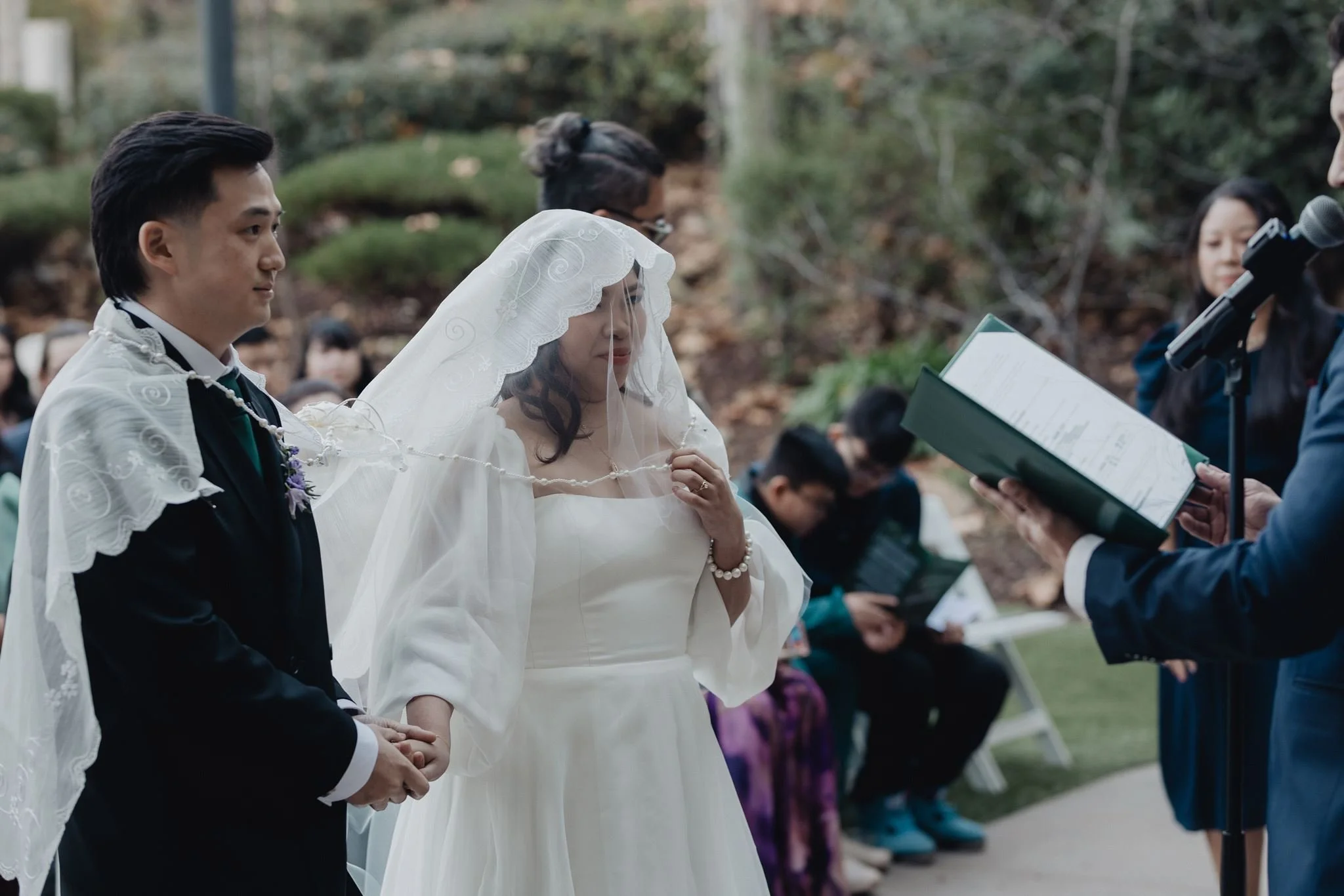
Veil sponsors pin a white veil over the bride’s head and across the groom’s shoulder, clothing the two of them as one. It is the most photogenic of the four and the one guests remember.
The cord
Cord sponsors lower the yugal — a cord, rope or oversized rosary — over the couple in a figure of eight. Laid on its side it is the symbol of infinity, and it is the last of the rites before the blessing.
The veil and cord usually stay in place until the end of the rite, then the same sponsors return to remove them. That removal is a second photograph, and it is the one most often missed.
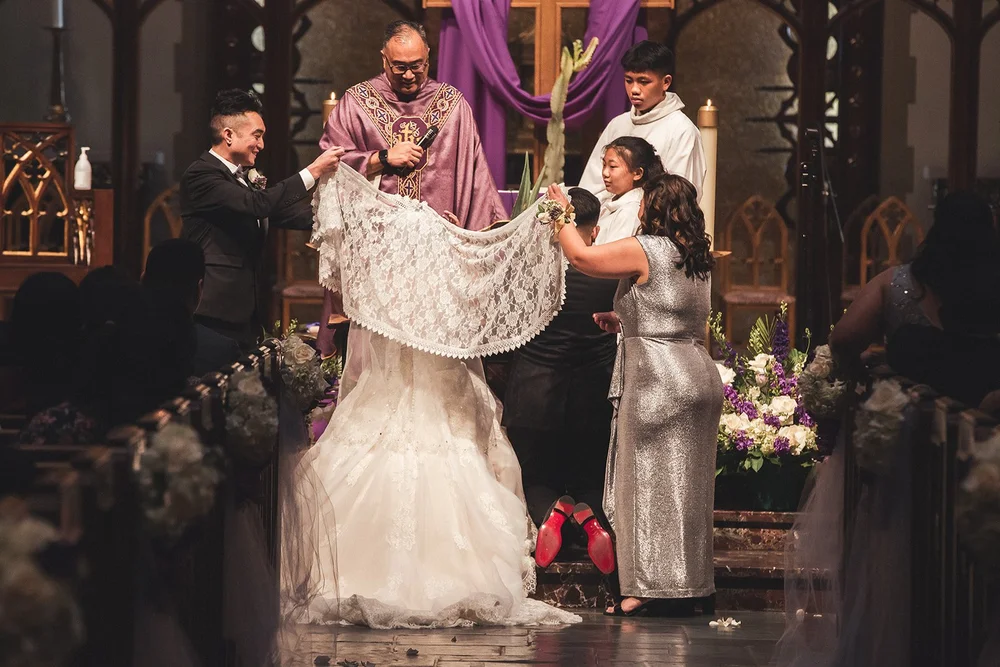
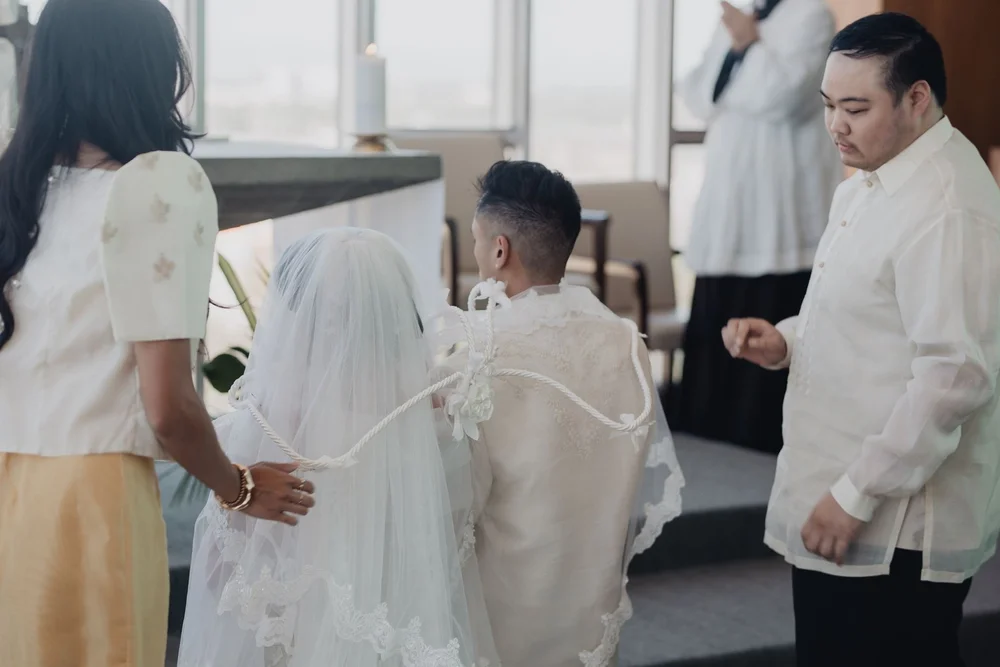
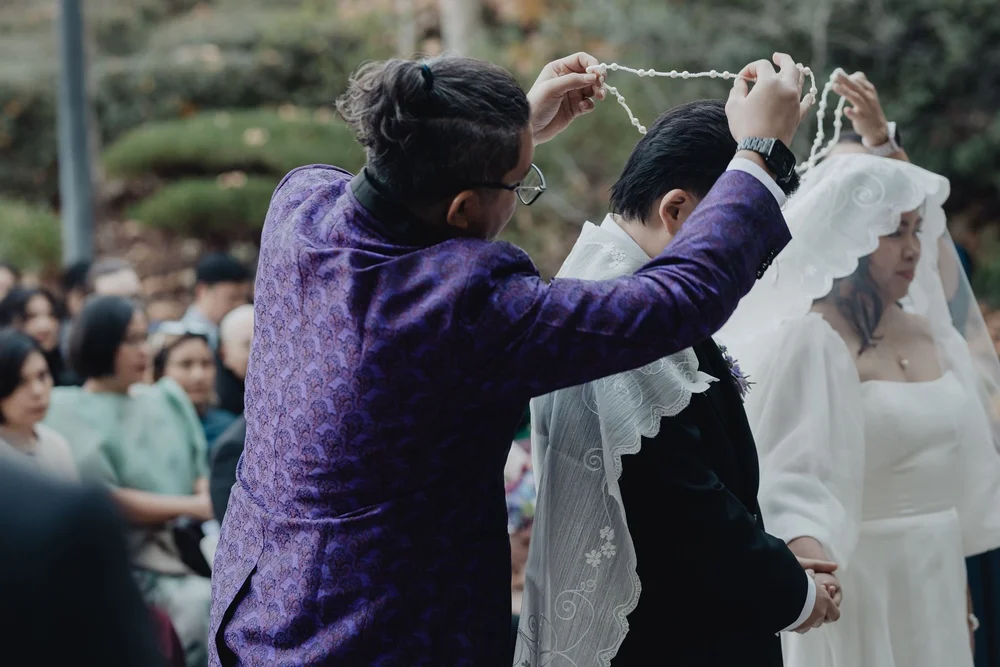
Candle, veil and cord ceremonies photographed across Los Angeles and Orange County.
Principal sponsors,and secondary sponsors.
Filipino weddings distinguish between the principal sponsors — the ninong and ninang, older relatives and mentors who act as witnesses and stand as godparents to the marriage — and the secondary sponsors, who physically perform the candle, veil and cord.
Secondary sponsors are usually younger: siblings, cousins, close friends. Being asked is an honour and a small job, and most of them are doing it for the first time. In practice that means somebody has to tell them where to stand, when to move and what to do with the pins — and it is worth doing that at the rehearsal rather than in front of two hundred guests.
Couples who are marrying across traditions often find a close parallel here: in Hispanic and Mexican Catholic weddings the lazo and the arras do almost exactly what the cord and the coins do. If both families are Catholic, the two versions can usually be reconciled into a single ceremony rather than performed twice.
Four rites, one aisle,and a priest in the way.
Know the running order
Coins, candle, veil, cord. Knowing which comes next is the whole job — each rite has one peak moment and it does not come back. We confirm the order with the officiant before the Mass.
Shoot from the side, not the aisle
Most parishes ask photographers to stay out of the center aisle and away from the sanctuary. Working the transepts gives cleaner angles than the aisle would anyway, with the sponsors’ faces rather than their backs.
Two cameras, two focal lengths
Wide for the sponsors and the altar together; long for the hands, the pins and the coins. Switching lenses in the middle of the veil is how you lose it.
Watch the hands
The coins pouring from palm to palm, the pin going into the veil, the cord settling on a shoulder. Every one of these rites is really a photograph of hands.
Available light in a dark church
Most parishes restrict or forbid flash during the Mass. We work fast lenses and high ISO so the pictures hold the color of the church rather than the color of a flash.
Photograph the removal too
The sponsors come back to take the veil and cord off. Couples almost never have that frame, and it is often the warmest one of the four.
Where these rites sit in the day
The veil, cord and coin rites happen inside the ceremony itself, so what really shapes a Filipino wedding timeline is the length of the service around them and how far the reception is.
A church mass, then a reception nearby
- 11:45 AMCoverage begins. Getting ready, details and family moments.
- 12:30 PMSponsors helping with the veil and blessings, then a first look if planned.
- 1:15 PMTravel and final pre-ceremony coverage.
- 2:00 PMCeremony begins. A full mass with the coin, candle, veil and cord rites runs sixty to ninety minutes.
- 3:15 PMFamily and sponsor photographs at the church.
- 4:00 PMTravel and portraits at a garden or park nearby.
- 5:00 PMStandby or break while the reception is set.
- 6:00 PMReception. Entrance, dinner, speeches, dancing.
- 8:30 PMCoverage concludes.
Eight hours, one venue
- 1:00 PMCoverage begins. Getting ready and candid storytelling.
- 2:15 PMFirst look, or pre-ceremony portraits kept separate for each side.
- 3:15 PMHideaway buffer, ceremony site details, guest arrivals.
- 3:45 PMCeremony, thirty to forty minutes, including the sponsors and the cord and veil.
- 4:30 PMGroup photographs with the sponsors and the full wedding party.
- 5:00 PMCouple portraits alongside cocktail hour.
- 5:45 PMReception, two to three hours of formalities and dancing.
- 9:00 PMCoverage concludes.
A morning ceremony and a daytime celebration
- 9:00 AMCoverage begins with getting ready.
- 10:15 AMPortraits with the wedding party and immediate family.
- 10:45 AMCeremony. Thirty minutes without the rites, about an hour with them.
- 11:45 AMFamily photographs, including the sponsors and everyone who took part in the rites.
- 12:15 PMThe celebration begins, or the couple leaves for portraits while the home is set.
- 1:00 PMCouple portraits at a scenic spot a short drive away.
What these rites need from the timeline
They are short, but they change the ceremony length and the number of people who have to be in position.
Where these weddings happen
Churches and venues that recur across the Filipino weddings we photograph.
- Christ Cathedral and the Tower of Hope
- Cathedral of Our Lady of the Angels
- St. Brendan Church
- Japanese Friendship Garden
- Green Gables Wedding Estate
- The Sanctuary, Long Beach
- Top of the Hub
- The Oviatt Penthouse
- Pasadena City Hall
- Balboa Park
Before the rehearsal.
What is the difference between principal and secondary sponsors?
Principal sponsors, the ninong and ninang, are older witnesses who stand as godparents to the marriage. Secondary sponsors are usually younger friends or siblings who physically perform the candle, veil and cord.
Why thirteen coins?
The arrhae are most often explained as Christ and the twelve apostles, or as one coin for each month of the year with a thirteenth to give away. Either way they stand for provision and shared trust between the couple.
What is the yugal?
The cord laid over the couple in a figure of eight. It can be a decorative rope, a silk cord or an oversized rosary. On its side the figure eight reads as the symbol of infinity.
How long do the four rites take?
Roughly eight to twelve minutes inside the Mass, performed one after another. They sit after the vows and rings and before the final blessing in most parishes.
Can we combine these with Mexican or Hispanic Catholic customs?
Usually yes. The lazo and the arras do almost exactly what the cord and coins do, so most officiants will reconcile them into one ceremony rather than run both.
Will the church let you photograph it?
Almost always, with conditions — typically no flash and no entering the sanctuary or center aisle. We ask the parish before the Mass and work within whatever they set.
The rest of the day.
Tell us about your ceremony.We reply within minutes.
Lulan Studio has photographed more than 2,300 weddings and holds 382 five-star reviews. Send us your date and your parish and we will tell you how we would cover the rites.