
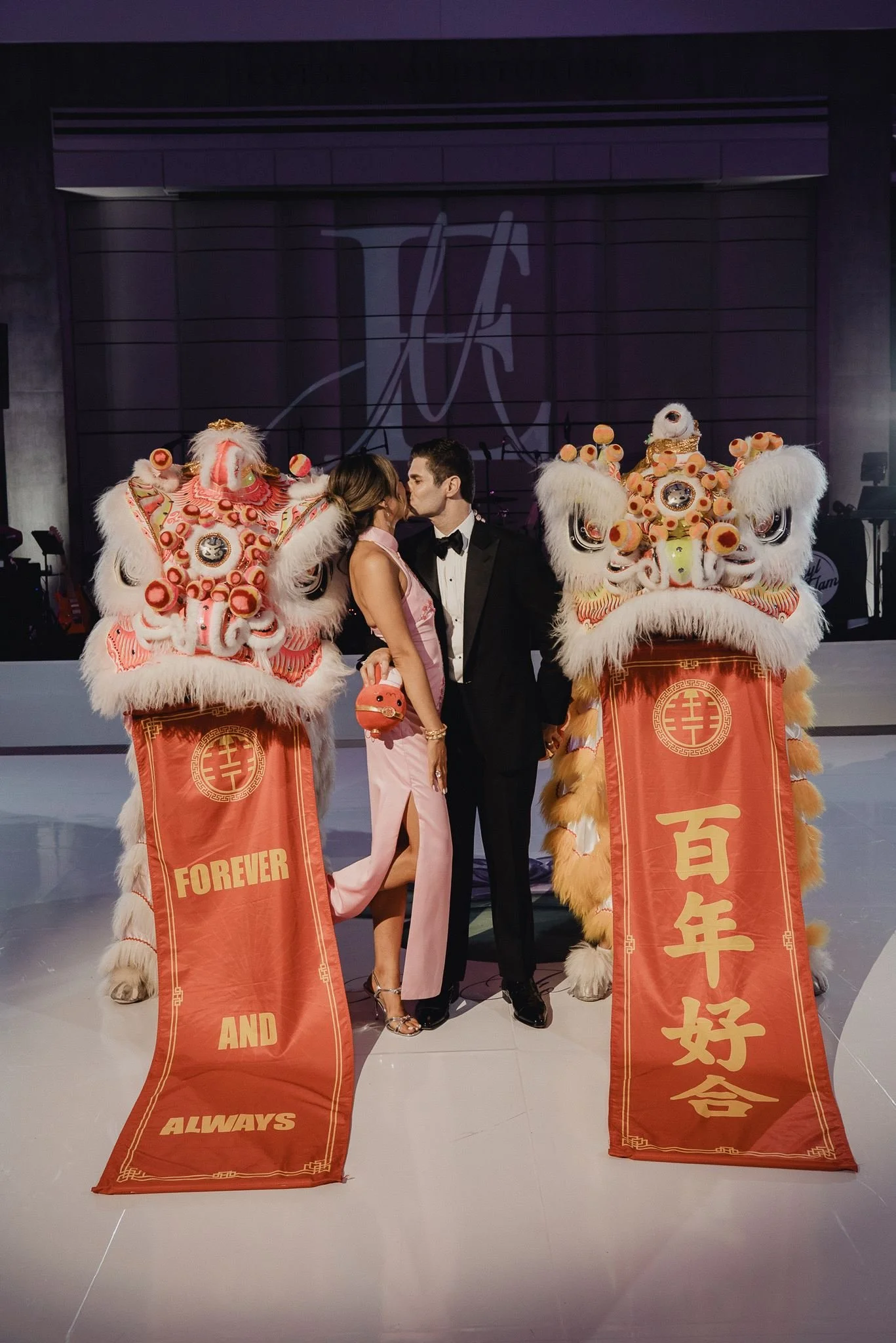
The Wedding
Lion Dance
What the lion is doing, when to schedule it, and how ten loud minutes get photographed properly
Two dancers, one lion,and a very large drum.
The lion dance — 舞獅, wǔsh B; — is not a costume parade. It is a performance art with a percussion score, and at a wedding it has a job: to clear bad luck out of the room and bring prosperity in. The lion arrives loud on purpose.
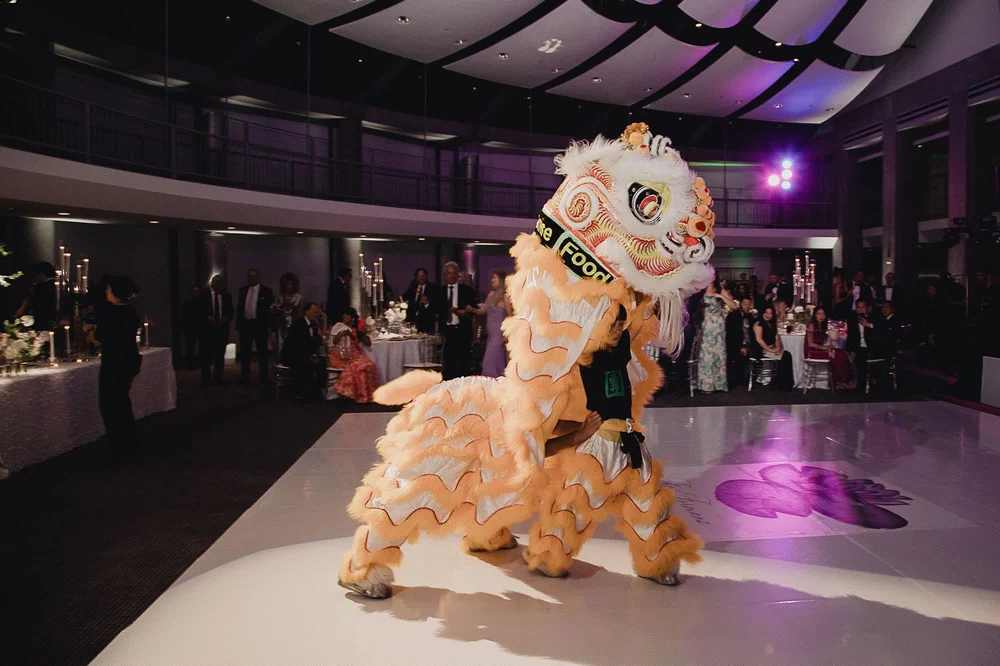
Each lion is worked by two performers, one at the head and one at the tail, moving as a single animal. The head operator controls the eyes, ears and mouth, which blink and snap on the beat. Behind them stands the band: a large drum, a pair of cymbals and a gong. The drum leads. Everything the lion does — the crouch, the shake, the sudden rear onto the tail dancer’s shoulders — is cued by it.
Almost every lion you will see at a Los Angeles wedding is a Southern lion (南獅), the Cantonese form, with a broad hinged face and a fringed body. The Northern lion (北獅) is shaggier, more acrobatic and rarer at weddings here. In the older tradition the lion’s colors carry characters drawn from the Three Kingdoms — yellow for Liu Bei, red for Guan Gong, black for Zhang Fei — though most modern troupes choose colors to match a couple’s palette rather than a legend.
Plucking the greens.The whole thing builds to this.
The climax of a wedding lion dance is 采青 — cǎi q B;ng, or choi cheng in Cantonese — “plucking the greens.” A head of lettuce is hung, placed on the floor, or handed up on a pole, with a red envelope tied to it.
The lettuce is not decorative. 生菜 sāng choi, lettuce, sounds like 生財 sāng choi, “generating wealth.” The lion stalks it, hesitates, inspects, and finally devours it — then scatters the shredded leaves back out over the couple and the guests. Fortune, distributed. The red envelope stays with the troupe.
If you photograph one frame of a lion dance, it is this one: the mouth wide, the leaves in the air, and a room of people laughing. It lasts about two seconds.
Tell your photographer where the greens will be placed before the music starts. It is the difference between standing in the right place and finding out from the back of the room.
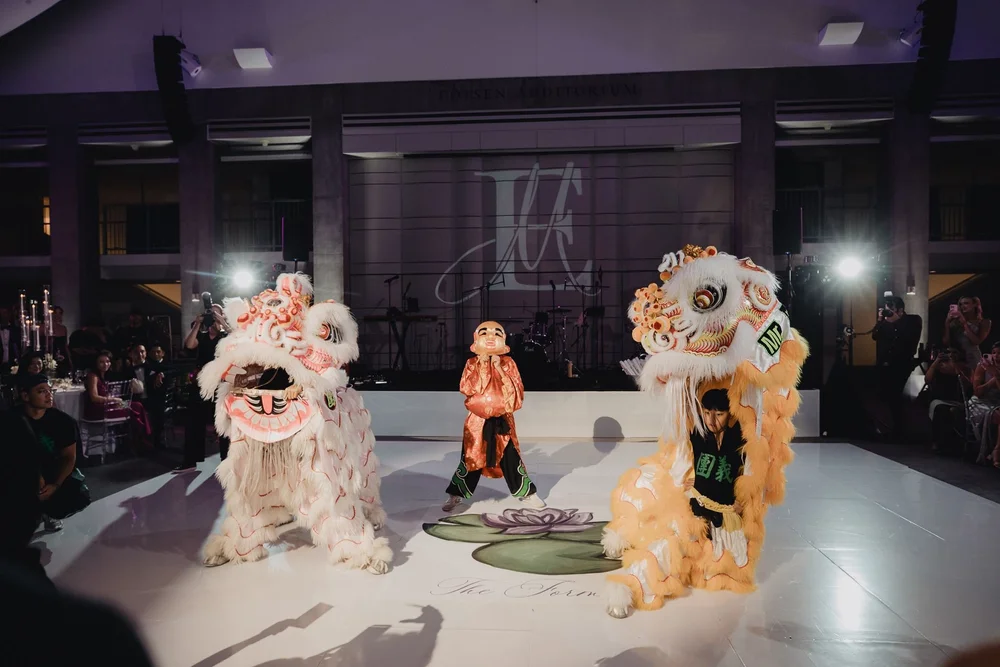
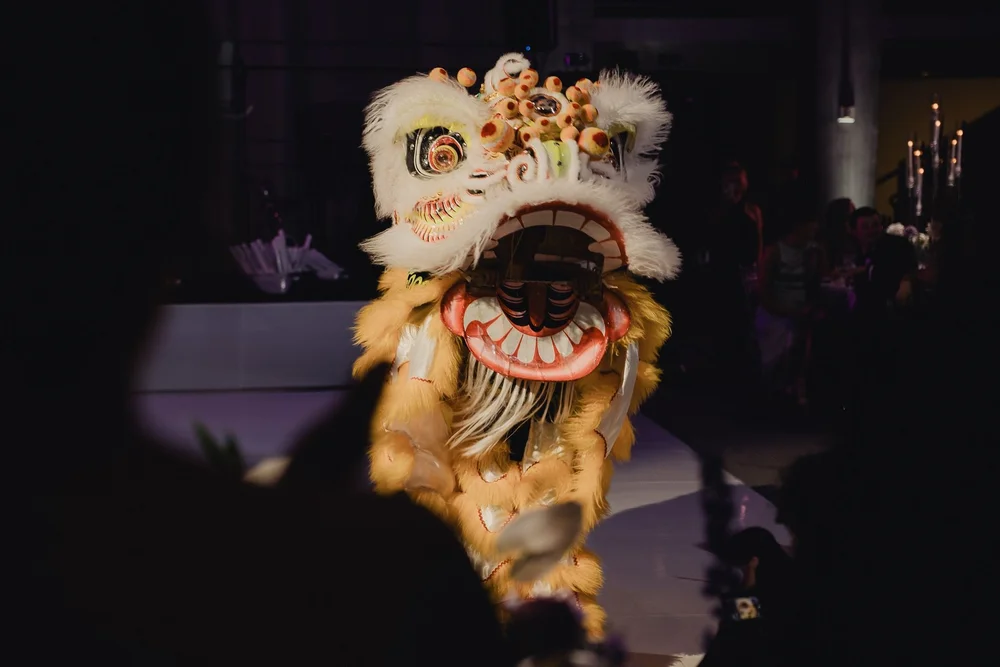
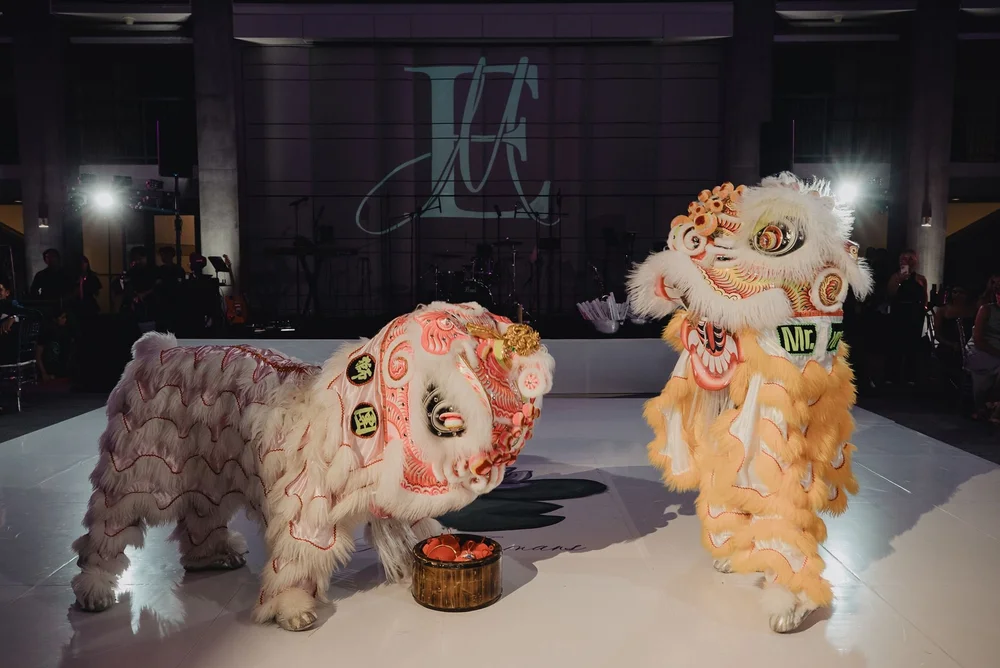
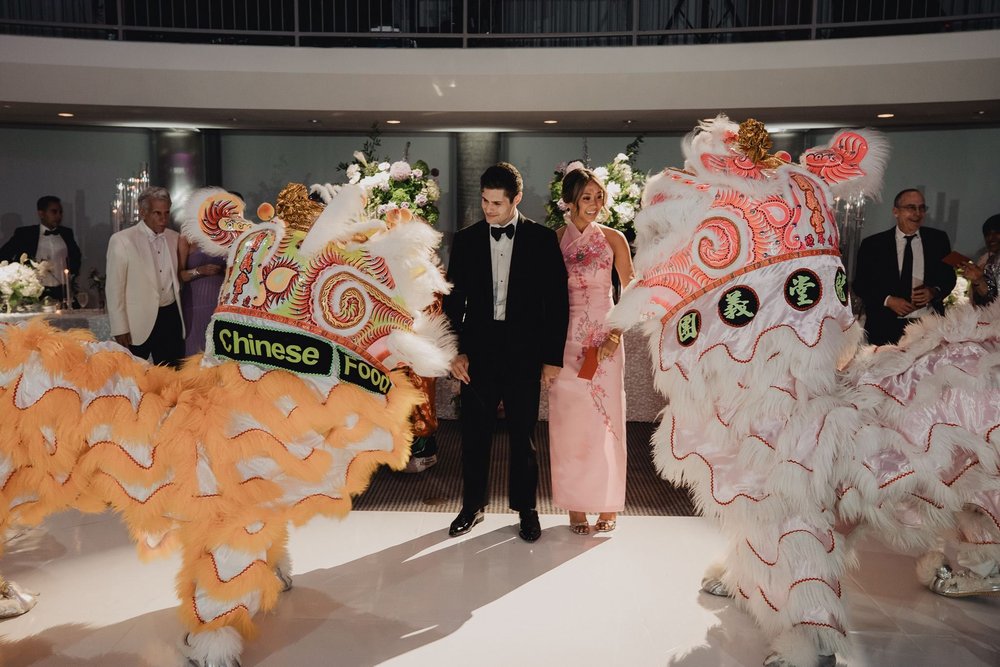
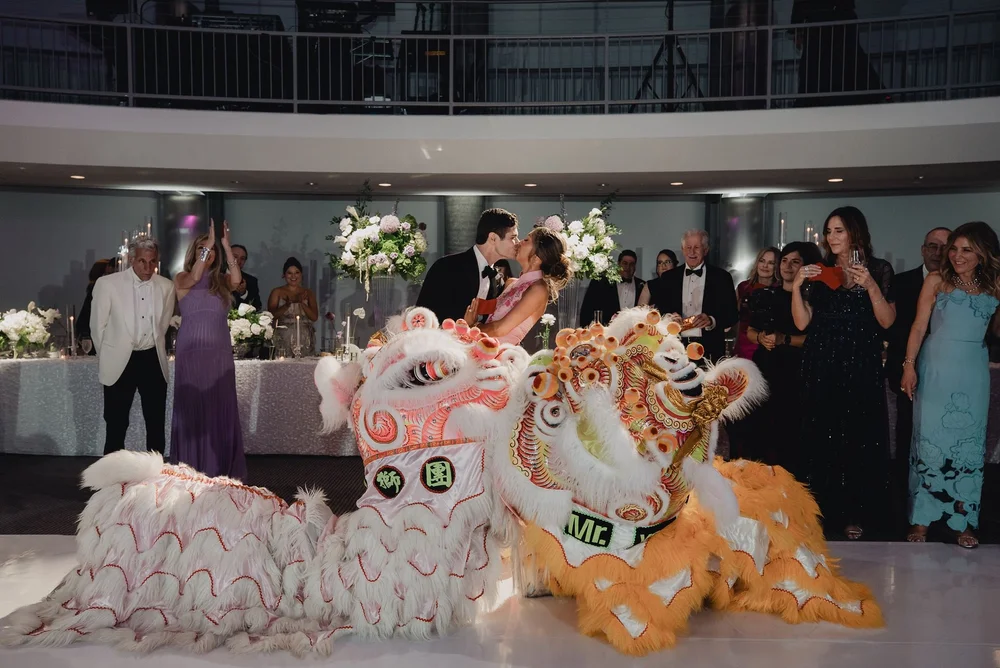
Lion dances photographed across Los Angeles and Orange County.
Four points in the daywhere a lion belongs.
A troupe is usually booked for a single ten to twenty minute set. Where you put that set changes the whole feel of it.
The door games
The lion leads the groom’s party to the bride’s door at the morning gate-crashing. Loud, chaotic, daylight, and usually the best-humoured version of the dance.
The tea ceremony morning
Performed at the family home or hotel suite before or after the tea is served. Tight spaces, low ceilings, and a lot of elders watching from sofas.
The banquet entrance
The lion meets guests at the ballroom doors and escorts the couple in. The classic placement, and the one most venues expect.
The reception grand entrance
Dance floor, uplighting, the couple introduced behind the lion. Visually the strongest, but the darkest to photograph.
Vietnamese families book the same performance under its own name, múa lân, and it appears at Chinese-Malaysian, Singaporean and Taiwanese weddings across Southern California too. It is not exclusively a Cantonese custom.
Fast, dark,and over before you can ask.
A lion dance is the hardest ten minutes on a Chinese wedding day to photograph well. It moves quickly, it usually happens in a dim ballroom, and nothing repeats.
Find the lane first
The lion travels a route — door to floor, floor to couple, couple to greens. We walk it with the troupe leader before the drum starts so we are never standing in it and never behind it.
Shutter speed over everything
The head snaps, the fringe flies, the tail dancer lifts. Slow shutters turn all of that to mush. We shoot fast and open, and accept grain over blur.
Two positions, not one
One of us stays wide on the room so you can see the crowd and the scale of it; the other works tight on the lion’s face and the drummer’s hands.
Watch the drummer
The drummer telegraphs everything. When the tempo doubles, the lion is about to rear or strike. Photographers who watch only the lion are always half a second late.
The red envelope and the leaves
The two frames that always matter: the envelope being accepted, and the shredded lettuce in the air. We pre-focus on the greens and wait.
Faces, not just the animal
Grandparents at the edge of the floor, children ducking behind parents, the couple laughing. The lion is the spectacle; the reactions are the photographs you keep.
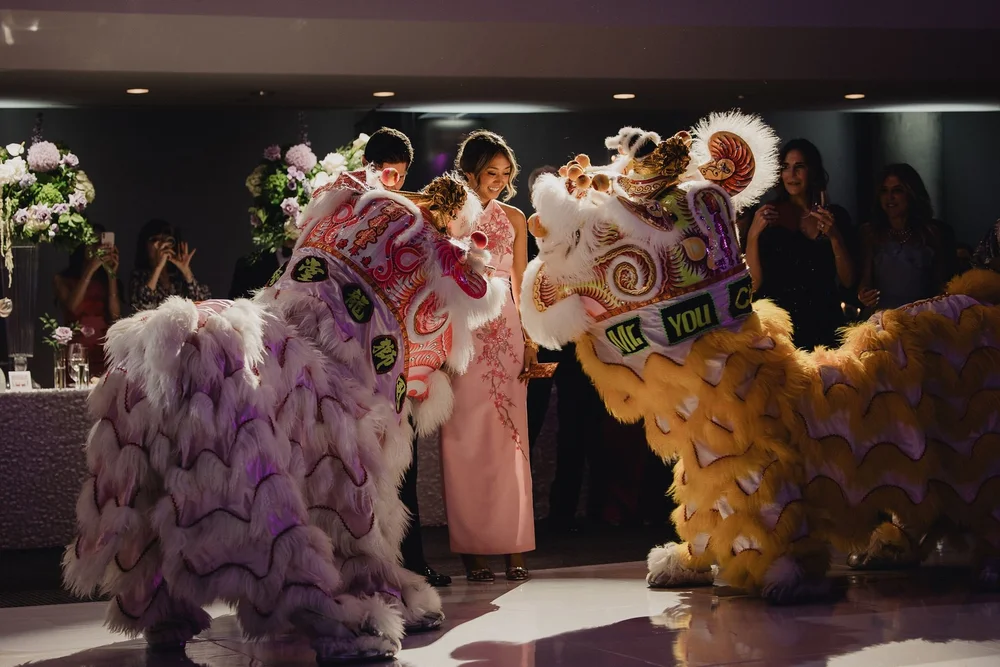
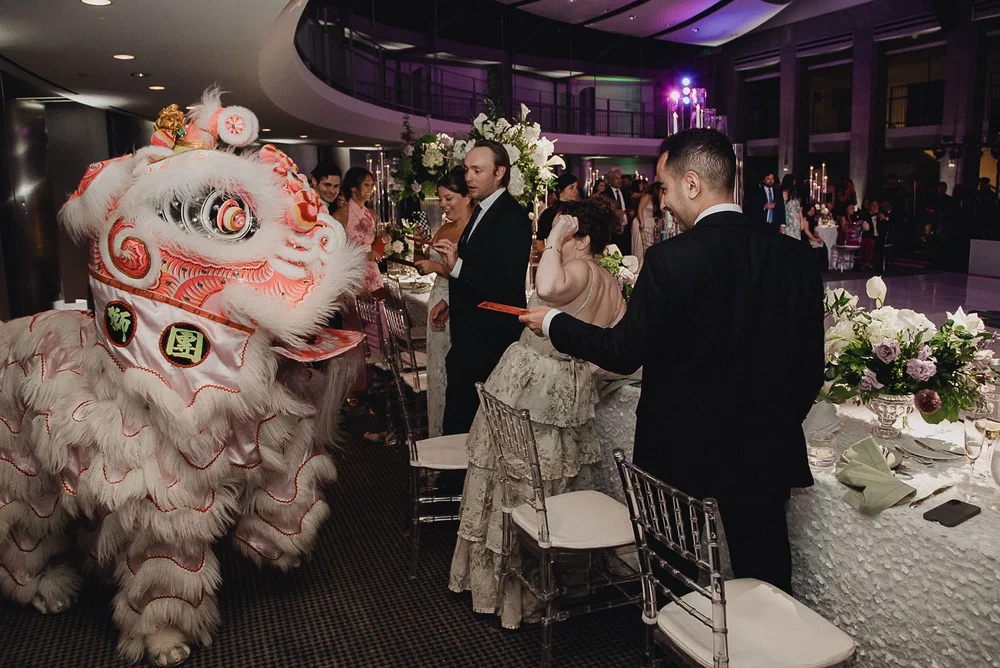
Things worth settling early.
One lion or a pair. A pair reads better in photographs and fills a ballroom properly; a single lion is easier in a house or a suite. Most troupes quote either.
Check the venue first. Drums and cymbals are genuinely loud, and hotels with adjoining event space, noise curfews or thin ballroom walls sometimes restrict them. Ask before you book the troupe, not after.
Ceiling height and floor space. The lion rears onto the tail dancer’s shoulders. Low chandeliers, tight door frames and crowded dance floors all limit what the troupe can perform.
Have the red envelopes ready. The greens carry one, and it is customary to have envelopes for the troupe. Give them to a family member who is not getting married that day.
Tell your planner where it sits in the timeline. Ten minutes of lion pushes everything after it. It is the single most common reason a banquet runs late, and the easiest to absorb if it is on the schedule.
How a Chinese wedding day is usually built
A lion dance sits inside a larger day, and where the other pieces fall decides where it can go. These are the shapes we photograph most, and the windows a lion dance fits into.
Evening banquet at a Chinese restaurant
- 4:00 PMCoverage begins at the restaurant. Room, backdrop and table details.
- 5:00 PMGuests arrive and mingle in a cocktail-style hour.
- 6:00 PMGrand entrance, then a welcome speech and introductions of both families.
- 6:45 PMLion dance, followed by photos of the couple and family with the lions.
- 7:15 PMDinner courses, with the couple visiting each table for a photo.
- 8:00 PMSpeeches, toasts and cake cutting.
- 8:30 PMA second round of table visits and family portraits.
- 9:30 PMGoodnights, then coverage concludes.
Morning tea ceremony, Western evening
- 9:00 AMCoverage begins at the family home. Details, decor, attire.
- 10:00 AMDoor games, then the tea ceremony. One to two hours with relatives served individually.
- 11:00 AMFamily and couple portraits in traditional attire.
- 11:30 AMLunch, travel, then a break with no active shooting.
- 2:30 PMCoverage resumes at the venue. Getting ready in the Western gown.
- 5:00 PMFamily photos, then the Western ceremony.
- 7:00 PMWedding party entrance, then the couple enters behind the lion dance.
- 7:30 PMDinner, toasts and first dance.
- 9:30 PMCoverage concludes.
One venue, lion dance at the grand entrance
- 1:30 PMCoverage begins. Details and getting ready.
- 3:00 PMFirst look, couple portraits and wedding party photos.
- 5:00 PMCeremony, about thirty minutes.
- 5:30 PMCocktail hour and family portraits.
- 6:45 PMGrand entrance. The lion dance comes in with the couple or right after them.
- 7:15 PMDinner and toasts. First dance during or after dinner.
- 9:30 PMOpen dancing, then coverage concludes.
Lion dance in the middle of the reception
- 7:00 PMGrand entrance of the couple and wedding party.
- 7:15 PMDinner service with speeches and toasts.
- 7:45 PMLion dance once guests are seated and fed. Ten to twenty minutes for the set.
- 8:15 PMPhotos of the couple and family with the lions.
- 8:30 PMTable visits or cake cutting.
- 9:00 PMFirst dance, parent dances and open dancing.
- 10:00 PMCoverage concludes.
Fitting a lion dance into the day
Where it sits, what it needs from the timeline, and the things worth agreeing with the venue.
Where these weddings happen
Restaurants, halls and venues that recur across the lion dance weddings we photograph.
- San Gabriel Valley banquet restaurants
- Orange County banquet restaurants
- Family homes in the San Gabriel Valley
- Padua Hills Theatre
- Richard Nixon Library
- The Ebell of Los Angeles
- Skirball Cultural Center
- Grand Tradition Estate
Before the drum starts.
How long does a wedding lion dance last?
Ten to twenty minutes for a standard set, including the entrance, the blessing of the couple and the plucking of the greens. Build twenty minutes into the timeline so it does not push the banquet.
Where in the day should we schedule it?
The four usual points are the morning door games, the tea ceremony, the banquet entrance and the reception grand entrance. The banquet entrance is the most common; the door games are the most fun to photograph.
What is the lettuce for?
Lettuce, sāng choi, is a homophone for “generating wealth.” The lion eats it and scatters the leaves over the couple and guests to spread fortune. A red envelope is tied to it for the troupe.
Do we need one lion or two?
Two fill a ballroom and photograph better; one is easier in a home, a suite or a tight venue. Ask your troupe what the space will take.
Will our venue allow it?
Most do, but drums and cymbals are loud enough that hotels with adjoining events or noise limits sometimes restrict them. Confirm with the venue before booking the troupe.
Is the lion dance only for Chinese weddings?
No. Vietnamese families book the same performance as múa lân, and it appears at Chinese-Malaysian, Singaporean and Taiwanese weddings across Southern California. We photograph all of them.
The rest of the day.
Tell us about your banquet.We reply within minutes.
Lulan Studio has photographed more than 2,300 weddings and holds 382 five-star reviews. Send us your date and where the lion is landing in your timeline, and we will tell you how we would cover it.