
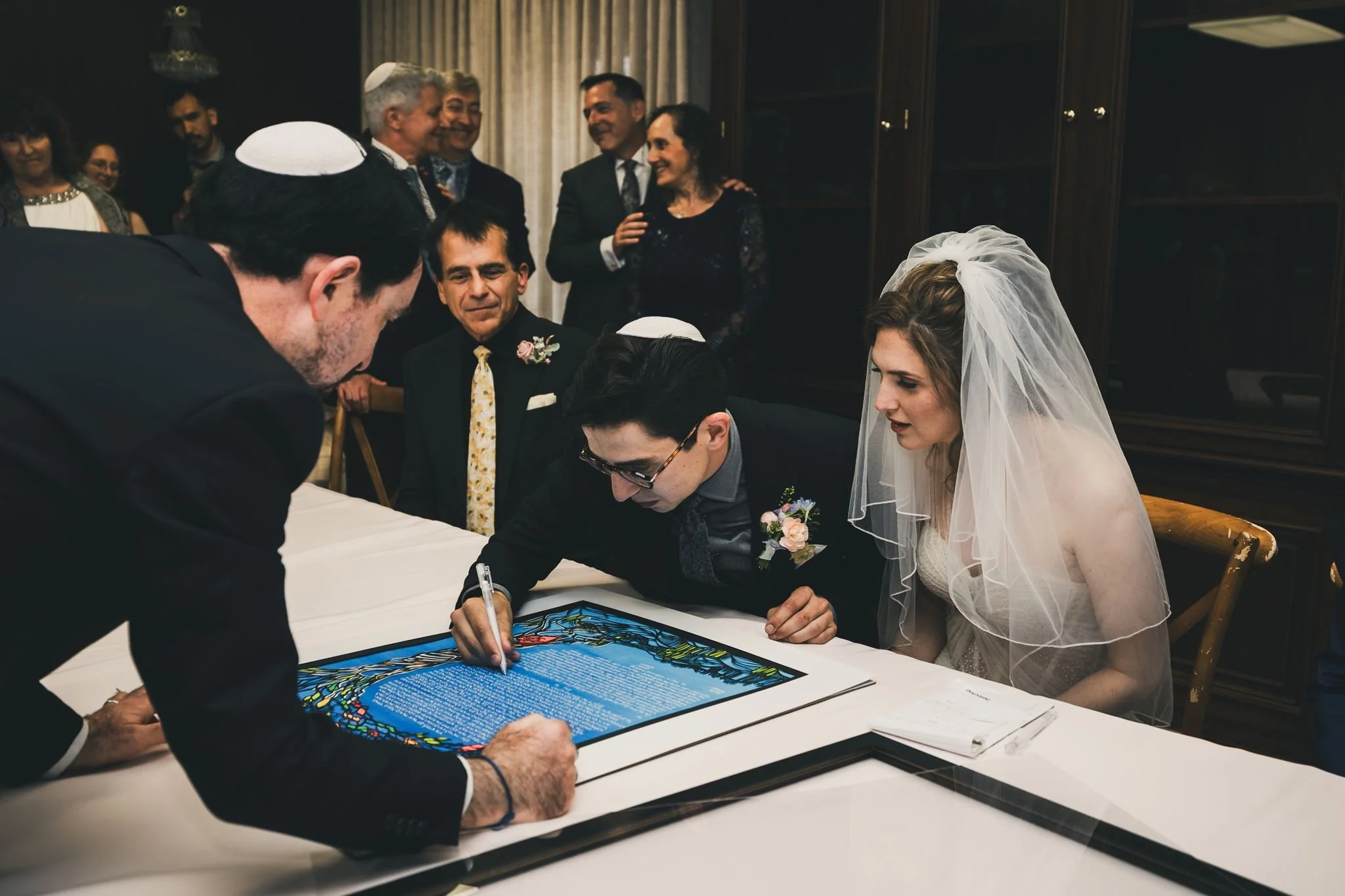
Ketubah Signing
Photography
What the document is, who signs it, and how the twenty minutes actually run
A contract, and a piece of art.Usually in that order.
A ketubah is the marriage contract read and signed at a Jewish wedding. The traditional text is written in Aramaic, and its substance is unromantic on purpose: it sets out what the husband owes the wife — food, clothing and conjugal rights, drawn from Exodus 21:10 — and the sum payable to her if the marriage ends in divorce or in his death. Rabbinic tradition attributes the document’s standard form to Shimon ben Shetach in the first century BCE, though scholars differ on its exact origins.
It is worth saying plainly what that meant at the time: the ketubah was a protection written for the wife, in an era when very little was. That is the reason it survived, and the reason it is still signed today even by couples whose marriage is governed entirely by civil law.
The second life of the ketubah is visual. From the medieval period onward, families commissioned illuminated ketubot — hand-lettered, gilded, bordered with papercuts and micrography. Most couples today commission an artist or buy a print, and the finished document is framed and hung at home. That is why the signing is worth photographing carefully: it is the only moment the artwork, the signatures and the people are all in the same frame.
Two witnesses, and it dependswho else.
The signatures that make a traditional ketubah valid belong to two witnesses, the eidim. Under Orthodox practice they must be halakhically qualified: adult, Jewish, observant, and unrelated to the couple or to each other. Being someone’s brother or best friend usually disqualifies you, which surprises families every time.
In strictly traditional ceremonies the couple does not sign at all. The groom instead performs kinyan sudar — a symbolic act of acceptance, usually lifting a handkerchief or pen handed to him by the rabbi — and the witnesses sign to attest that he did. It is a small gesture, it happens fast, and it is the single easiest thing on the whole day to miss if nobody has told you it is coming.
Conservative, Reform and independent communities generally do it differently. Both partners sign, the witnesses are often close friends or siblings rather than halakhically qualified strangers, and the text may be egalitarian, bilingual, interfaith, or written by the couple themselves. Conservative ketubot frequently include the Lieberman clause. Same-sex couples typically use a mutual text in which both partners make identical commitments.
Ask your officiant which version applies to you, and tell your photographer. The order of events, the number of people in the room and the moment worth waiting for all change depending on the answer.
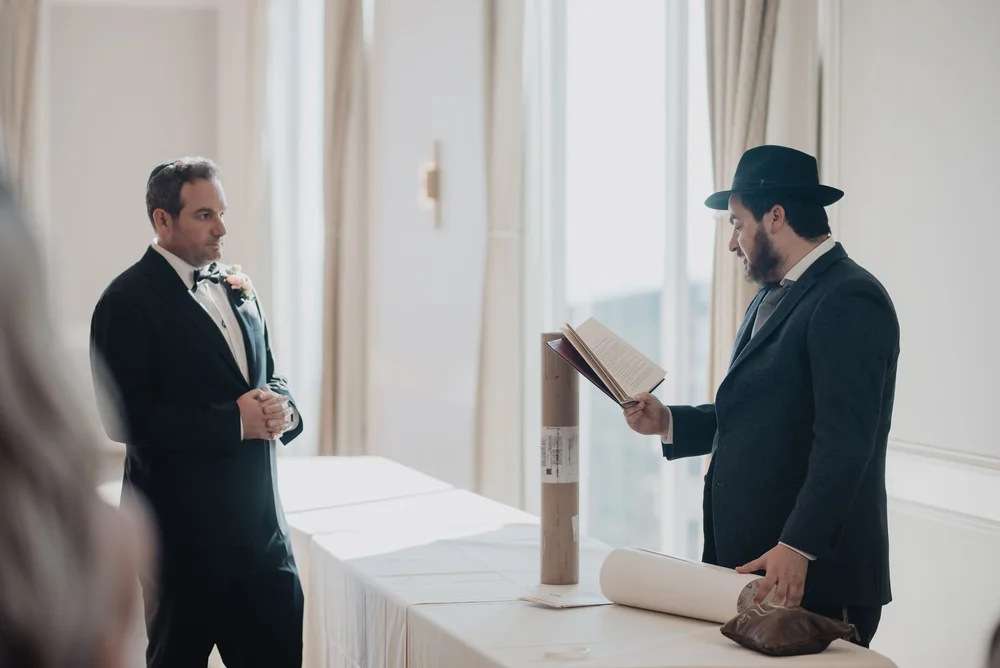
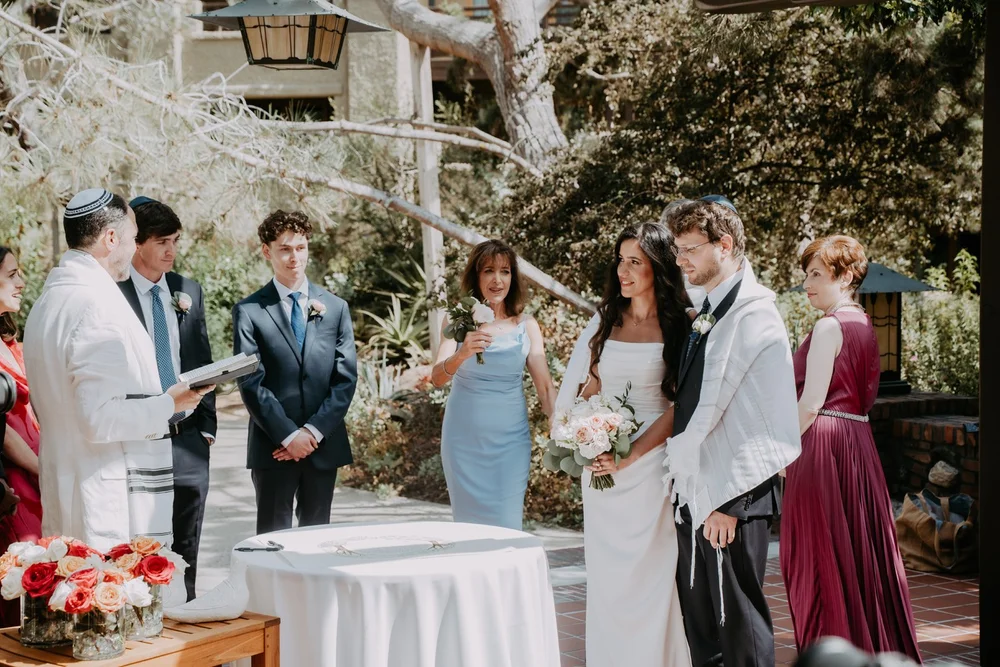
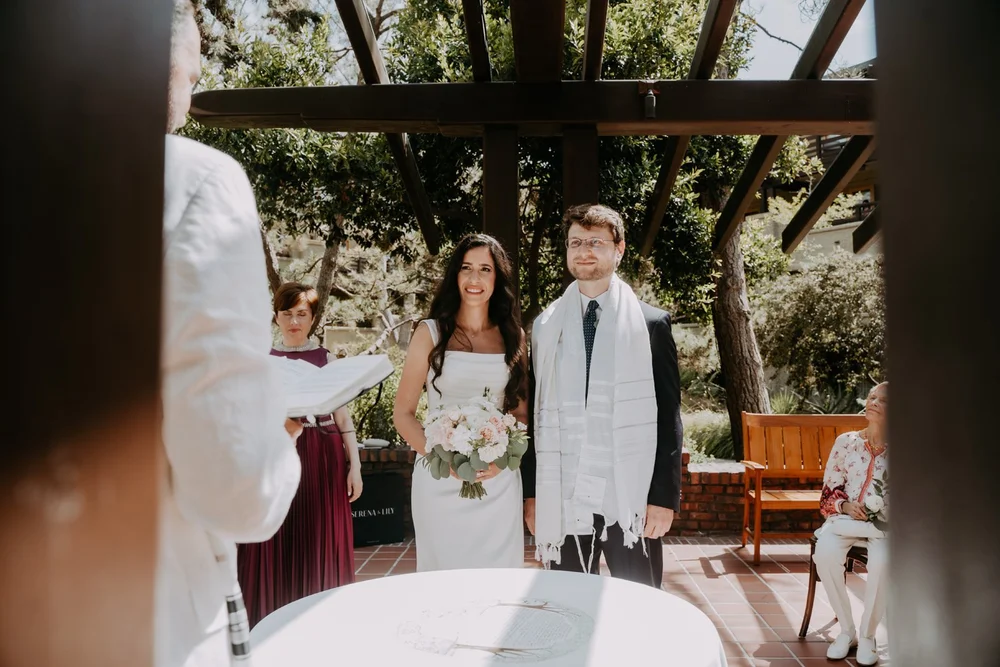
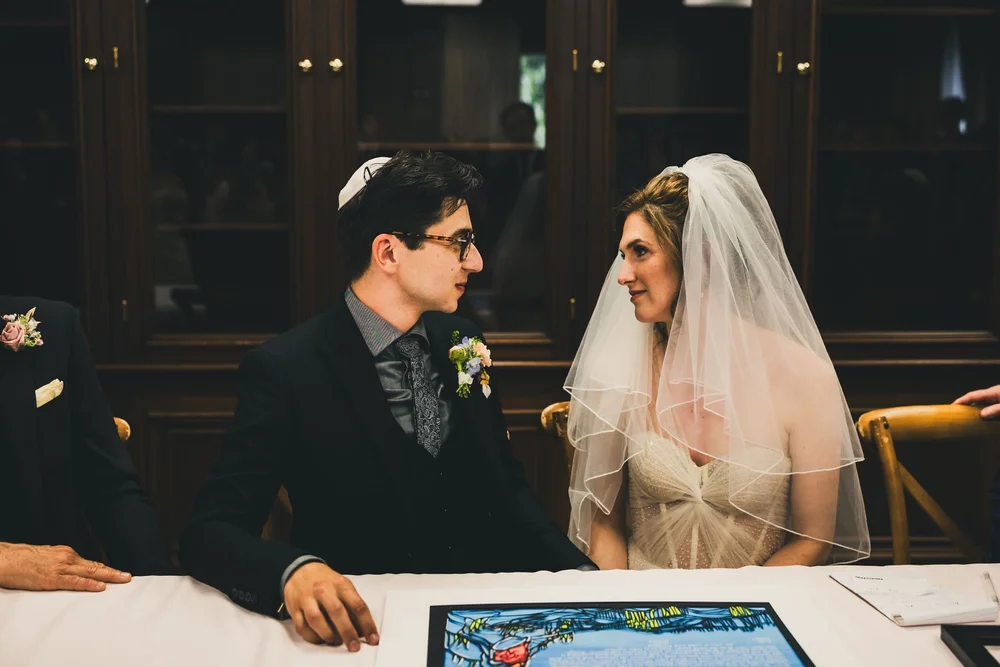
Ketubah signings photographed across Los Angeles, Orange County and Santa Barbara.
Before the aisle,behind a closed door.
The signing happens before the ceremony, not during it, and it is almost always the first formal gathering of the day. Immediate family, the wedding party, the officiant and the witnesses crowd into a side room, a suite, a library, a green room — whatever the venue has. It runs twenty to forty minutes with the surrounding customs included.
The room fills
Parents, grandparents, siblings and the wedding party arrive. This is often the first time both families are in one space, and it is frequently the warmest twenty minutes of the day.
The tish, if there is one
In more traditional weddings the groom holds a tish — a short gathering with singing, a drink and a deliberately interrupted talk on the week’s Torah portion.
The reading and the kinyan
The officiant reads or summarises the text, explains what the witnesses are attesting to, and the acceptance is performed.
The signatures
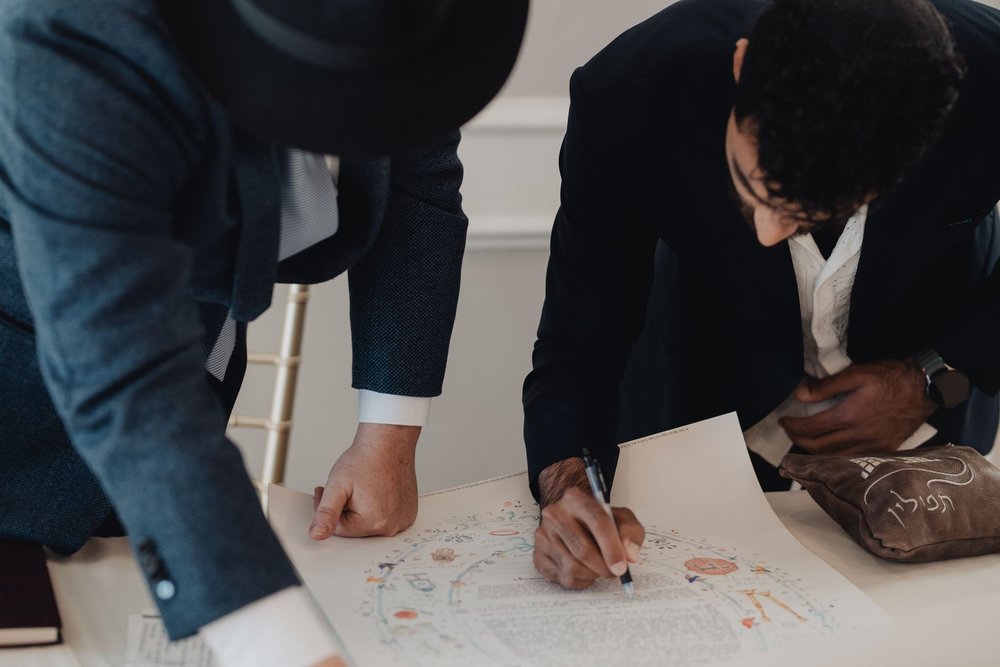
Witnesses sign, then the couple in most modern ceremonies, then the officiant. Pens are passed. Someone always has to be told where to write.
The bedeken
In many weddings the groom immediately veils the bride. It is short, loud and emotional, and it usually happens within a minute of the last signature.
Straight to the processional
There is rarely a gap. Build the schedule so nobody is walking down the aisle out of breath.
Small room. Low light.One chance at each beat.
The ketubah signing is the hardest-lit twenty minutes of a Jewish wedding, and it is not repeatable. These are the working rules we hold to.
Ask the officiant first
Before anyone sits down we ask where to stand, whether flash is acceptable and whether there is a moment they would rather we did not shoot. Some rabbis want stillness during the reading. Knowing that in advance is worth more than any lens.
Two frames of everything
One wide that holds the room, the family and the document together; one close on the hands, the pen and the artwork. The wide frame is the one families ask for years later, because it is the only picture with everybody in it.
Watch the hands, not the faces
The kinyan is a handkerchief passing between two people and it takes about a second. Cameras pointed at faces miss it.
Photograph the document flat
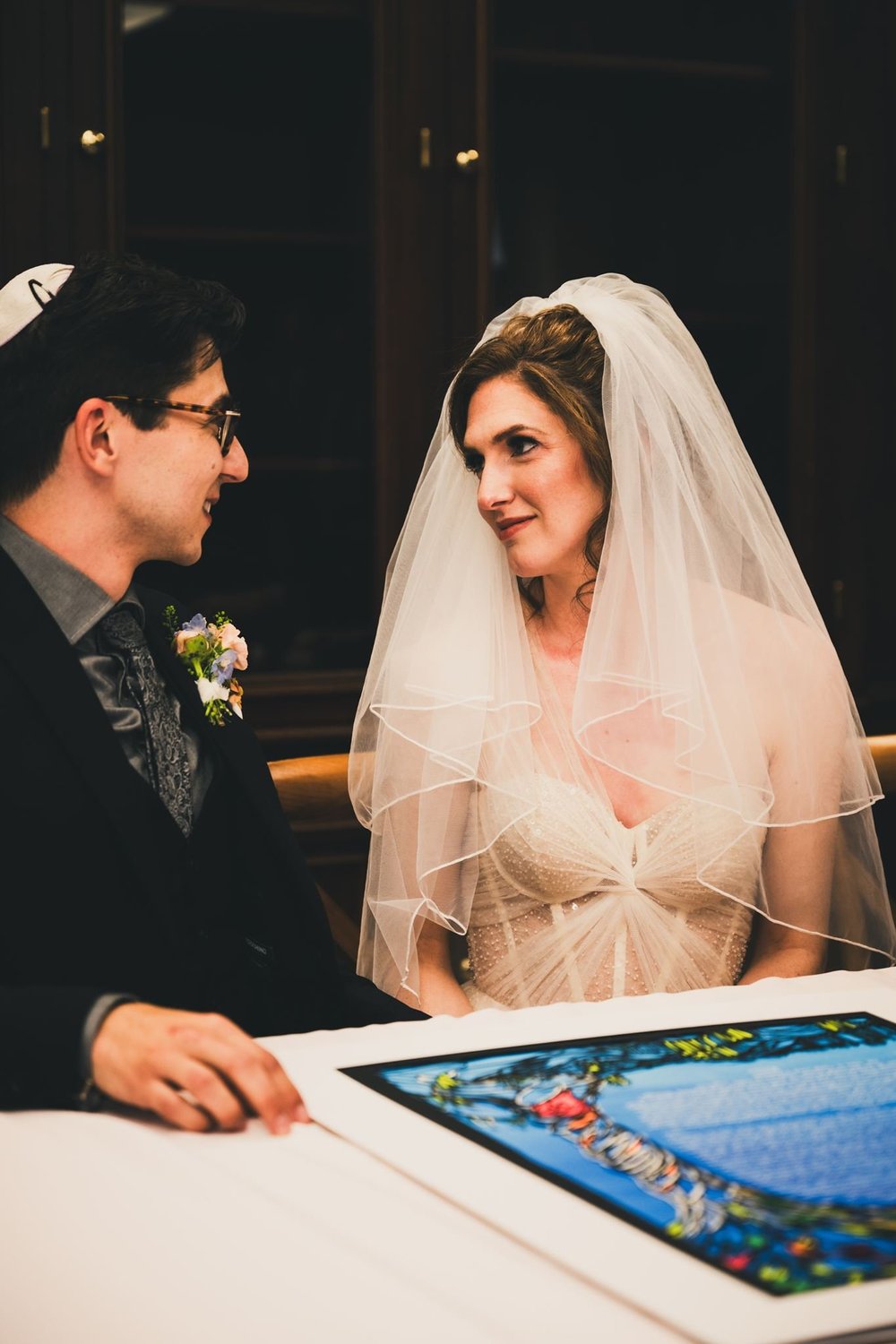
Once the signatures are dry we take the ketubah somewhere with clean, even light and shoot it square-on as an artwork in its own right. Couples frame that photograph as often as they frame the original.
Available light where we can
Signings happen in dim rooms with mixed color temperatures. We work fast lenses first and add light only when the room genuinely cannot carry the frame, so the pictures look like the room felt.
Second photographer on the door
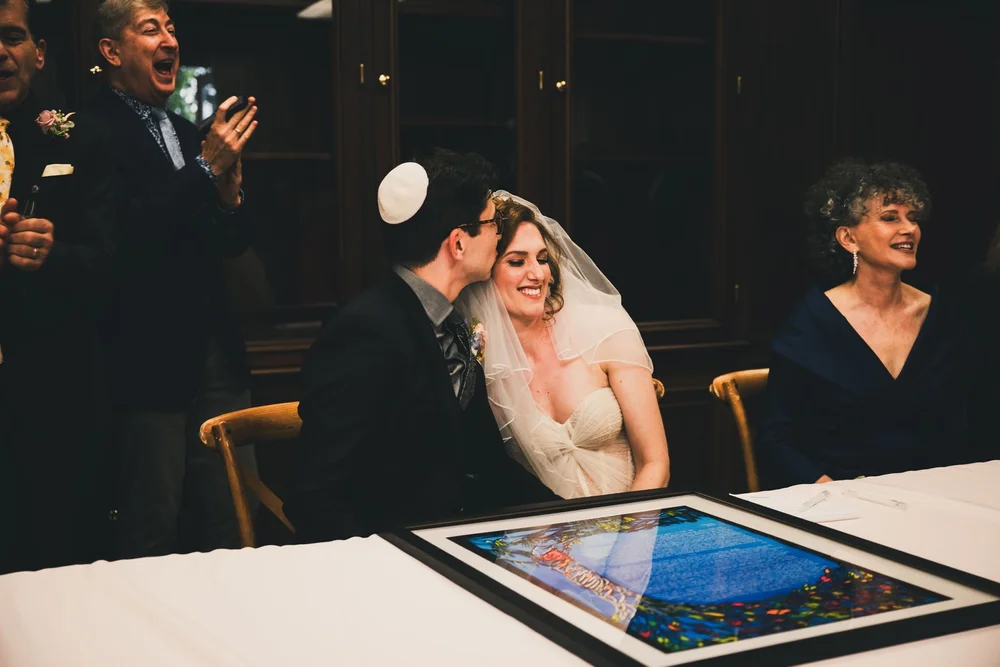
With two of us, one works the table and one works the reactions — the mother watching, the grandfather leaning in. Those frames are usually the ones that end up on the wall.
It goes on a wall,not in a drawer.
Under the chuppah the ketubah is usually read aloud, in Aramaic, in English, or both, and then handed to the couple — traditionally the husband gives it to the wife, and in halakhah it remains hers. After the wedding most couples frame it and hang it at home. If a traditional ketubah is ever lost, a replacement document, a ketubah d’irkasa, is written to take its place.
Practically, that means the document has a long life in the couple’s house and a short one on the wedding day. Give it fifteen honest minutes and good light, and you get both the ceremony record and the artwork reproduction out of the same twenty minutes.
Where the signing sits in the day
The ketubah signing is a short, private moment that has to be placed carefully, because everything around it, the portraits, the guest arrival and the ceremony, is competing for the same forty five minutes.
Signing before an evening ceremony
- 3:00 PMCoverage begins. Final hair and makeup, dress and detail shots.
- 4:00 PMFirst look, then couple portraits.
- 4:30 PMWedding party portraits, full group and each side.
- 5:00 PMKetubah signing with close family and friends, in a quiet room near the ceremony space.
- 5:15 PMFreshen up and line up. The team photographs guests arriving and the decor.
- 5:30 PMCeremony.
- 6:00 PMYichud, about fifteen minutes. Guest candids meanwhile.
- 6:15 PMJust-married portraits while the light holds.
- 7:15 PMReception, then the hora and open dancing.
A later ceremony timed to sundown
- 3:00 PMCoverage begins at the getting ready location.
- 4:15 PMFirst look and family photographs, all completed before the ceremony.
- 5:30 PMKetubah signing.
- 6:30 PMCeremony, timed to sundown.
- 7:00 PMYichud, then cocktail hour outside the ceremony and reception rooms.
- 8:00 PMReception in the same space after the room is turned.
- 9:00 PMThe hora, then open dancing.
- 11:00 PMCoverage concludes with the party continuing.
A compact eight-hour day
- 2:00 PMCoverage begins. Getting ready, dress, shoes, details.
- 3:00 PMFirst look, couple portraits, family and wedding party groups.
- 4:30 PMKetubah signing.
- 5:00 PMCeremony.
- 5:30 PMCocktail hour with any extended family groups.
- 6:45 PMReception. First dance, speeches, dinner, then dancing.
- 10:00 PMCoverage concludes.
Signing after the ceremony
- 3:00 PMCoverage begins. Getting ready and details.
- 5:00 PMFinal preparations and relaxed family photographs.
- 6:00 PMCeremony under the chuppah.
- 6:30 PMKetubah signing in a private room with immediate family.
- 7:00 PMWedding party and couple portraits while guests finish cocktail hour.
- 7:15 PMReception. Dinner, parent dances and open dancing.
- 11:00 PMCoverage concludes.
How much time the signing needs
Practical numbers from the signings we photograph, and the choices that make the rest of the afternoon work.
Where these weddings happen
Venues that recur across the Jewish weddings we photograph.
- Westlake Village Inn
- Castle Green
- LA River Center & Gardens
- Skirball Cultural Center
- Le Meridien Delfina
- Descanso Gardens
- The Oviatt Penthouse
- Sephardic Temple, Westwood
- Family homes and estates
Before the pens come out.
When in the day does the ketubah signing happen?
Before the ceremony, usually thirty to sixty minutes before the processional, and almost always in a private room rather than the ceremony space. Allow twenty to forty minutes including the tish and the bedeken if you are having them.
Do both of us sign it?
It depends on your officiant and your community. In Orthodox practice the witnesses sign and the couple does not; the groom performs a symbolic act of acceptance instead. In Conservative, Reform and independent ceremonies both partners normally sign. Ask your rabbi, then tell your photographer, because it changes where we stand.
Who can be a witness?
Under Orthodox practice, two adult, observant Jewish witnesses who are not related to the couple or to each other. Other communities are considerably more flexible and often choose close friends or siblings. Your officiant will confirm what your ketubah requires.
Can you photograph the ketubah itself?
Yes, and we recommend it. Once the signatures are dry we photograph the document flat in even light, so you have a clean reproduction of the artwork alongside the pictures of the signing.
What if our officiant does not want photography during the signing?
We follow the officiant, always. We ask before the room fills, work from where they ask us to work, and photograph the arrival, the reactions and the document afterwards instead. It has never cost a couple the coverage they wanted.
Do you photograph interfaith and same-sex ketubah signings?
Yes. Egalitarian, bilingual, interfaith and mutual-commitment texts are common in Los Angeles and we photograph them the same way we photograph any other — by asking what matters to you first, then covering it properly.
The rest of the ceremony.
Tell us about your ceremony.We reply within minutes.
Lulan Studio has photographed more than 2,300 weddings and holds 382 five-star reviews. Send us your date and your officiant’s name and we will tell you exactly how we would cover your signing.