
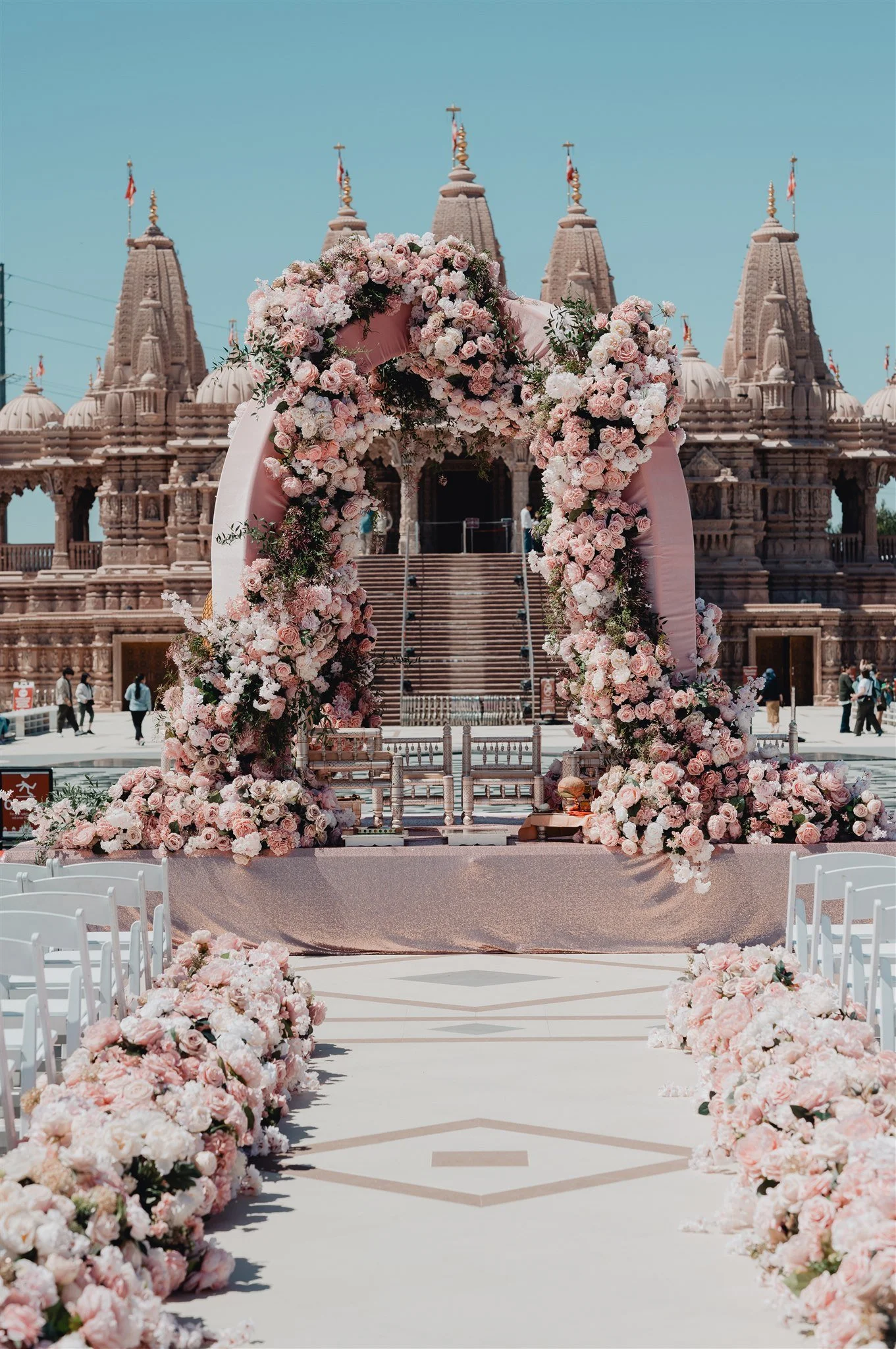
Auspicious wedding datesfor 2027 & 2028, decoded
Every South Asian family arrives at a wedding date differently — a pandit with two birth charts, a Tamil panchangam, a Bengali panjika, a gurdwara diary, a nikah in Shawwal. This is the two-year map underneath all of it: which months are open in 2027 and 2028, which are closed and why, and what that means when you are booking a venue in Los Angeles rather than a courtyard in Chennai.
Two-thirds of the year is open. The trouble is that everyone wants the same third.
A traditional Hindu wedding date has to clear four calendar-level gates before anyone looks at a single day. Those gates close the same broad stretches of the year for nearly every family — which is why late summer and early autumn empty out, and why February, May and November fill up eighteen months in advance. Sikh, Muslim and many Christian South Asian families are not bound by those gates at all, and often have the pick of exactly the weekends everyone else has to skip.
Tap any month to open it day by day in the date checker below.
The whole page in plain English
- A muhurat is a lucky time for the wedding, worked out from the Hindu calendar. Many Hindu families will only marry inside one.
- Some parts of the year are closed to weddings for almost every Hindu family. In 2027 and 2028 the big gap is August to October, plus a few weeks each winter and spring.
- Because of that, the open months — especially February, May and November — get booked up early. Start looking at venues 12 to 18 months out.
- Sikh, Muslim and many Christian families don't need a muhurat, so they can use the weekends everyone else has to skip.
- Use this page to make a shortlist. Then ask your family's priest (pandit) to confirm the exact day and time for the city you are marrying in.
Muhurat
A lucky window of time for the ceremony, calculated from the Hindu calendar. It can be as short as twenty minutes.
Panchang
The Hindu almanac. It lists each day's moon phase, star and other details your priest uses to pick a date.
Pandit
A Hindu priest. Usually the person who confirms your muhurat and performs the ceremony.
Chaturmas
A four-month rest period in the Hindu year, roughly July to early November. Weddings are not held during it.
Kharmas
Two month-long pauses — mid-December to mid-January and mid-March to mid-April — when weddings are set aside.
Combust (Asta)
When Venus or Jupiter sits so close to the Sun that it can't be seen. Weddings wait until the planet is visible again.
Nakshatra
One of 27 star groups the Moon passes through. Only 11 of them are considered good for a wedding.
Abujh muhurat
A handful of days considered lucky all on their own — no calculation needed.
Five gates, in order
A muhurat is not one calculation. It is a sequence of filters, each applied to the whole calendar before the next one runs. Understanding the order is what lets you predict your own year instead of waiting on a phone call from someone's uncle in Ahmedabad.
The solar month
In short: two month-long pauses, when the Sun sits in certain signs — about mid-December to mid-January, and mid-March to mid-April. Late summer is paused too.
Read the detailsShow less
The first filter is where the Sun sits. Weddings are set aside while the Sun passes through Sagittarius (roughly 15 December to 14 January) and Pisces (roughly 14 March to 13 April) — the periods most families call Kharmas or Malmas. A second stretch closes in late summer when the Sun moves through Leo and Virgo. These windows move by only a day or two a year, which is why the January and April openings land on almost the same dates in both 2027 and 2028.
KharmasMalmasSolar month shuddhiThe lunar year
In short: a four-month rest in the Hindu year with no weddings — about mid-July to early November in 2027, and early July to late October in 2028.
Read the detailsShow less
Chaturmas is the four-month rest that begins on Devshayani Ekadashi and ends on Devutthana (Prabodhini) Ekadashi. Nothing is solemnised inside it. In 2027 it runs from around 13 July to around 9 November. In 2028 it starts earlier — around 3 July — and lifts around 28 October. That single shift is the biggest practical difference between the two years.
An Adhik Maas, the intercalary thirteenth lunar month, wipes out another four weeks whenever it falls. Neither 2027 nor 2028 has one — the last was in 2026 and the next is expected in 2029 — which is why both years read as unusually generous compared with 2026.
No Adhik Maas in 2027 or 2028ChaturmasVenus and Jupiter have to be visible
In short: weddings wait while Venus or Jupiter is hidden in the Sun’s glare. These stretches last weeks and can wipe out an otherwise good month.
Read the detailsShow less
This is the gate most couples have never heard of and the one that does the most damage to a shortlist. Classical texts hold that marriage rites are not performed while Venus (Shukra) or Jupiter (Guru) is combust — too near the Sun to be seen at dawn or dusk. Those asta periods run for weeks at a time and have nothing to do with the rest of the calendar, so they can land inside an otherwise perfect month.
Most panchangs also add a buffer on either side: shishutva, the planet's "infancy" in the days just after it reappears, and vriddhatva, its "old age" in the days before it sets. In 2027 an unusually long Venus combustion from late July into mid-September is the reason August and September are completely empty even where Chaturmas alone would have allowed a day or two. In 2028 the same phenomenon clips the end of May, the start of June, and the first half of October.
Shukra AstaGuru AstaShishutvaVriddhatvaThe day itself — Panchang Shuddhi
In short: only now are single days checked. What survives is a window of a few hours — sometimes at dawn, sometimes overnight.
Read the detailsShow less
Only now does anyone look at individual dates. Four elements of the panchang are checked against the surviving days: the nakshatra (of the twenty-seven, eleven are accepted for marriage — Rohini, Mrigashira, Magha, Uttara Phalguni, Hasta, Swati, Anuradha, Mula, Uttara Ashadha, Uttara Bhadrapada and Revati), the tithi, the yoga (Vishkambha, Atiganda, Shula, Ganda and Vyaghata are excluded) and the karana.
What survives is not a day. It is a window of hours — sometimes twenty minutes, sometimes overnight into the following morning. This is why a published "date" so often carries a ceremony time that looks impossible, like 4:48 a.m., and why the pheras can be scheduled hours apart from the reception.
NakshatraTithiYogaKaranaThe two of you
In short: your priest checks both of your birth charts. Public lists give you a shortlist; only this step gives you your date.
Read the detailsShow less
Everything above is public and can be looked up. The last gate cannot. A family pandit takes both birth charts and runs Lagna Shuddhi and Navamsha Shuddhi, checks for Lattadi dosha, and weighs Mangal dosha and the Ashta Kuta score from the kundali matching. A date on every published list can still be wrong for you, and a date on none of them can be right.
So treat the calendars below as the shortlist your family will choose from — never as the answer.
Lagna ShuddhiNavamsha ShuddhiKundali Milan2027 and 2028, month by month
Published lists disagree — widely. For 2027 the totals range from the mid-thirties to the mid-nineties, because some sources count an overnight window as one date and some as two, and because different schools apply the yoga and karana filters differently. The windows below are stable across every source we checked. The individual dates are candidates to take to your pandit, not a booking sheet.
Why this month looks like thisShow less
Window edges are approximate (± a day). Every date is a candidate to confirm with your pandit, computed for your wedding city.
Read all 24 months as notesThe full month-by-month detail for 2027 and 2028
2027
Opens mid-January · closes mid-July · reopens 9 NovemberJanuary
Opens mid-monthClosed to ~14 Jan · open 15–31 Jan
Kharmas holds the first fortnight while the Sun is in Sagittarius. Once it lifts, the month is clear — Venus is not combust, unlike January 2026.
18, 19, 20, 24, 26, 27, 30, 31 ~10 candidate days
February
OpenWhole month
No calendar-level restriction anywhere in the month. One of the two or three most contested months of the year for venues.
2, 3, 10, 11, 14, 15, 21, 22, 25–28 14–15 Feb carry Rohini
March
Closes mid-monthOpen 1–13 Mar · closed from ~14 Mar
A short spring window, then the Sun enters Pisces and Kharmas returns for a month. Holashtak also clips the run-up to Holi in some traditions.
1, 2, 3, 4, 9, 10, 11 ~6–7 candidate days
April
Opens mid-monthClosed to ~13 Apr · open 14–30 Apr
Kharmas ends and the long spring season begins. The second half of April is the start of the strongest continuous run of the year.
18, 19, 21, 23, 24, 25, 26, 27, 28 ~9 candidate days
May
OpenWhole month
The largest month of 2027 on every list we compared. No Adhik Maas this year, so nothing interrupts it.
4, 7, 9, 13, 14, 15, 16, 17, 18, 23, 24, 30, 31 Busiest month of the year
June
OpenWhole month
Strong right through. In North America this is the month where the muhurat calendar and the domestic wedding season collide hardest.
1, 5, 9, 10, 11, 12, 13, 15, 16, 20 ~12–16 candidate days
July
Closes ~13 JulOpen 1–12 Jul
Devshayani Ekadashi falls around 13 July and Chaturmas begins. Venus goes combust roughly a week later. The season ends here.
1, 7, 8, 9, 11, 12 Last dates before the pause
August
ClosedNo dates
Chaturmas plus an unusually long Venus combustion. Even days with a qualifying nakshatra do not survive.
— Gate II + Gate III
September
ClosedNo dates
Venus combust into mid-September, Jupiter combust from around the 13th, the prohibited solar month, and Pitru Paksha on top.
— Every gate shut at once
October
ClosedNo dates
Chaturmas runs the whole month in 2027 and does not lift until the second week of November. Diwali falls inside the pause.
— Chaturmas
November
Opens ~9 NovClosed to ~8 Nov · open 9–30 Nov
Devutthana Ekadashi lands around 9 November and the season reopens. Three weeks of dates, and the single most competitive stretch of the year.
10, 11, 15, 16, 20, 21, 23, 24, 25, 26, 29 15 Nov carries Rohini
December
Closes ~14 DecOpen 1–14 Dec · closed from ~15 Dec
A tight fortnight before Kharmas returns. The last usable dates until the middle of January 2028.
2, 7, 8, 9, 12, 13, 14 13 Dec: Rohini on Purnima
2028
~77 dates · Chaturmas starts earlier · November is the year's best monthJanuary
Opens mid-monthClosed 1–14 Jan · open from ~15 Jan
Same shape as 2027. Eight dates, three of them on a weekend.
15, 16, 17, 18, 19, 21, 22, 31 8 dates · 3 weekend
February
OpenWhole month · no restriction
Sixteen dates on the lists we compared, eight of them on a weekend — the strongest month in the first half of the year. A leap year, and 29 February appears on several lists.
1, 5, 6, 10, 11, 12, 13, 15, 17, 19, 20, 21, 22, 26, 27, 28 16 dates · 8 weekend
March
Closes ~13 MarOpen 1–13 Mar
Six dates, then the Sun enters Pisces and the month shuts.
3, 4, 5, 9, 12, 13 6 dates · 3 weekend
April
Opens ~14 AprClosed 1–13 Apr · open from ~14 Apr
Seven dates in the back half, two on a weekend. Akshaya Tritiya falls in this window in most years — see the abujh muhurat note below.
14, 15, 16, 21, 26, 27, 28 7 dates · 2 weekend
May
Closes ~24 MayOpen 1–24 May · Venus combust from ~25 May
Thirteen dates and six weekends before Shukra Asta begins — the best single block of the first half of 2028, but it ends abruptly.
13 dates through ~24 May 13 dates · 6 weekend
June
Opens ~10 JunVenus combust to ~9 Jun · open 10–30 Jun
A narrow three-week corridor between the end of the Venus combustion and the start of Chaturmas. Only two of the eight dates fall on a weekend.
8 dates, 10–30 Jun 8 dates · only 2 weekend
July
ClosedNo dates
Devshayani Ekadashi falls around 3 July — ten days earlier than in 2027 — and Chaturmas closes the month immediately.
— Chaturmas from ~3 Jul
August
ClosedNo dates
Prohibited solar month across the whole of August, inside Chaturmas.
— Gate I + Gate II
September
ClosedNo dates
Prohibited solar month, then Jupiter goes combust. Nothing survives.
— Guru Asta begins
October
Two dates onlyEffectively closed until ~29 Oct
Jupiter stays combust to around 13 October and Chaturmas runs to around the 28th. Two dates survive at the very end of the month — sources place them on 29–30 or 30–31 October.
~30, 31 2 dates · both weekdays
November
OpenWhole month · no restriction
The best month of the two years: eleven to twelve dates with no calendar-level restriction at all, and roughly half of them on a weekend. Expect venues to be gone early.
4, 5, 6, 10, 11, 13, 16, 18, 19, 21, 26, 27 11–12 dates · ~6 weekend
December
Closes ~14 DecOpen 1–14 Dec · closed from ~15 Dec
Seven dates, four of them on a weekend — a better-shaped fortnight than December 2027 for anyone who needs a Saturday.
7 dates, 1–14 Dec 7 dates · 4 weekend
The date belongs to the family. The hour belongs to the sky.What every pandit we have worked with has said, one way or another
How different South Asian families set the date
"South Asian" covers a dozen calendars and at least four religions. The Hindu muhurat system above is the one most people mean, but it is not the only one, and for a significant share of families it does not apply at all.
North Indian Hindu
The calendar on this page, in its standard form: the purnimanta lunar month, the eleven marriage nakshatras, Chaturmas and Kharmas as the dominant blackouts. Gujarati families often also check vinchudo — an inauspicious band within the lunar month — and Marathi families weigh the Shalivahana Shaka calendar's own reckoning of the month.
MoreShow less
Most multi-day North Indian weddings hang the whole structure off the muhurat hour: the baraat is timed to arrive before it, the jaimala and pheras inside it, the vidaai after.
South Indian Hindu
A different reckoning, not a variation on the same one. Tamil families use the Tamil panchangam and its solar months, and avoid Aadi (mid-July to mid-August), Purattasi (mid-September to mid-October) and Margazhi (mid-December to mid-January) for weddings. Malayali families set aside Karkidakam. Telugu and Kannada families follow the amanta lunar month, so their month boundaries fall roughly a fortnight from the North Indian ones — which is exactly why two sides of one family can be given different "same" dates.
MoreShow less
A South Indian muhurtam is also usually much earlier in the day. Sunrise ceremonies are normal, and that has real consequences for a photography and film schedule.
Bengali & Assamese
Bengali families work from a panjika rather than a generic panchang, and there are two competing ones — the Bishuddha Siddhanta and the Gupta Press — which do not always publish the same wedding days. The panjika prints its biye dates directly, month by month in the Bengali calendar, so a Bengali family will usually arrive with a printed list rather than a calculation.
MoreShow less
Ask early which panjika the family uses. It is the single most common source of a two-week disagreement.
Sikh
The Sikh Rehat Maryada discourages consulting horoscopes or any other practice aimed at fixing an auspicious wedding date or time, and sets no restriction on when an Anand Karaj may be held. In practice many Punjabi Sikh families still take a date from a pandit out of family custom, and many do not — both are common in Southern California.
MoreShow less
The constraint that does bind is a different one. A 2023 Akal Takht hukamnama prohibits taking the Guru Granth Sahib saroop to resorts, beaches and destination venues, so the Anand Karaj itself is held in a gurdwara. Plan the ceremony and the reception as two locations, and build travel time between them into the schedule.
Muslim
A nikah is valid on any day. There is no muhurat and no astrological filter, which in practice means South Asian Muslim families can take the Saturdays that Hindu families cannot — a real advantage in a market this crowded.
MoreShow less
What shapes the calendar instead is the Islamic year. Most families avoid Ramadan, and many avoid the first ten days of Muharram. Shawwal, the month after Ramadan, is often preferred on the strength of Sunnah. Because the Hijri calendar shifts about eleven days earlier each year, Ramadan falls in roughly February–March in 2027 and February–March in 2028 — worth plotting against your venue shortlist before you tour anywhere.
Jain, Nepali, Sri Lankan & South Asian Christian
Jain families use a Jain panchang with its own vivah muhurat list and observe Chaturmas strictly, with Paryushan inside it. Nepali families work from the Bikram Sambat calendar and the Nepali patro; the windows are close to the North Indian ones but the month names and the published dates are their own.
MoreShow less
Sri Lankan couples use nekath — auspicious times from the Sinhala litha, or the Tamil panchangam for Sri Lankan Tamil families — and nekath are often specified to the minute, with the tying of the thali or the stepping onto the poruwa fixed precisely. South Asian Christian families, particularly Kerala Syrian Christian and Goan Catholic, set the date by church availability and the liturgical calendar instead, avoiding Lent and Advent — and keep every other cultural element of the wedding intact.
The days that need no muhurat at all
A handful of tithis are held to be abujh or swayam siddha — auspicious in themselves, needing no calculation. A wedding may be held on one of these without consulting a panchang or a chart at all. They are the reliable escape hatch when a family cannot agree, and they are worth knowing because they can also fall inside a blocked month.
Basant Panchami
Late January or February. Widely used across North India and among Punjabi families, and often the first realistic date after the Kharmas pause lifts.
Akshaya Tritiya
April or May. The most used of the four, and the one that most often produces a mid-week wedding — it lands where it lands, and families take it anyway.
Devutthana (Dev Uthani) Ekadashi
Late October or November. The day Chaturmas ends. Enormously popular precisely because it is the first day of the reopened season — which also makes it the hardest day of the year to book a venue, a caterer or a band.
Vivah Panchami
November or December. The anniversary of Rama and Sita's wedding. Observed strongly in Mithila, Bihar and Nepal, less so elsewhere — and some families deliberately avoid it, reading the couple's later story as an ill omen. Ask before you assume.

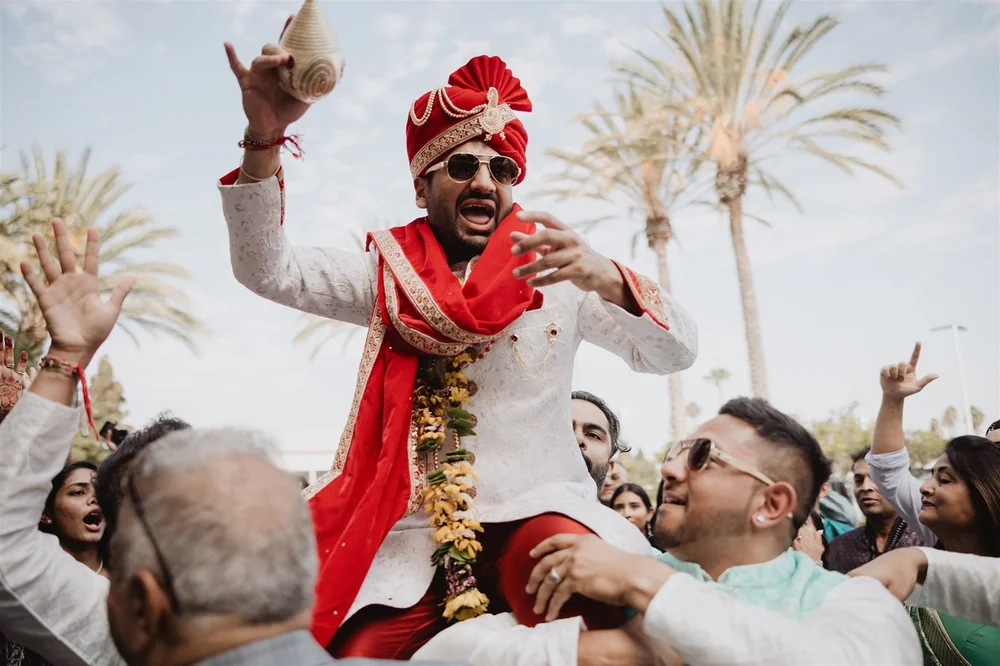
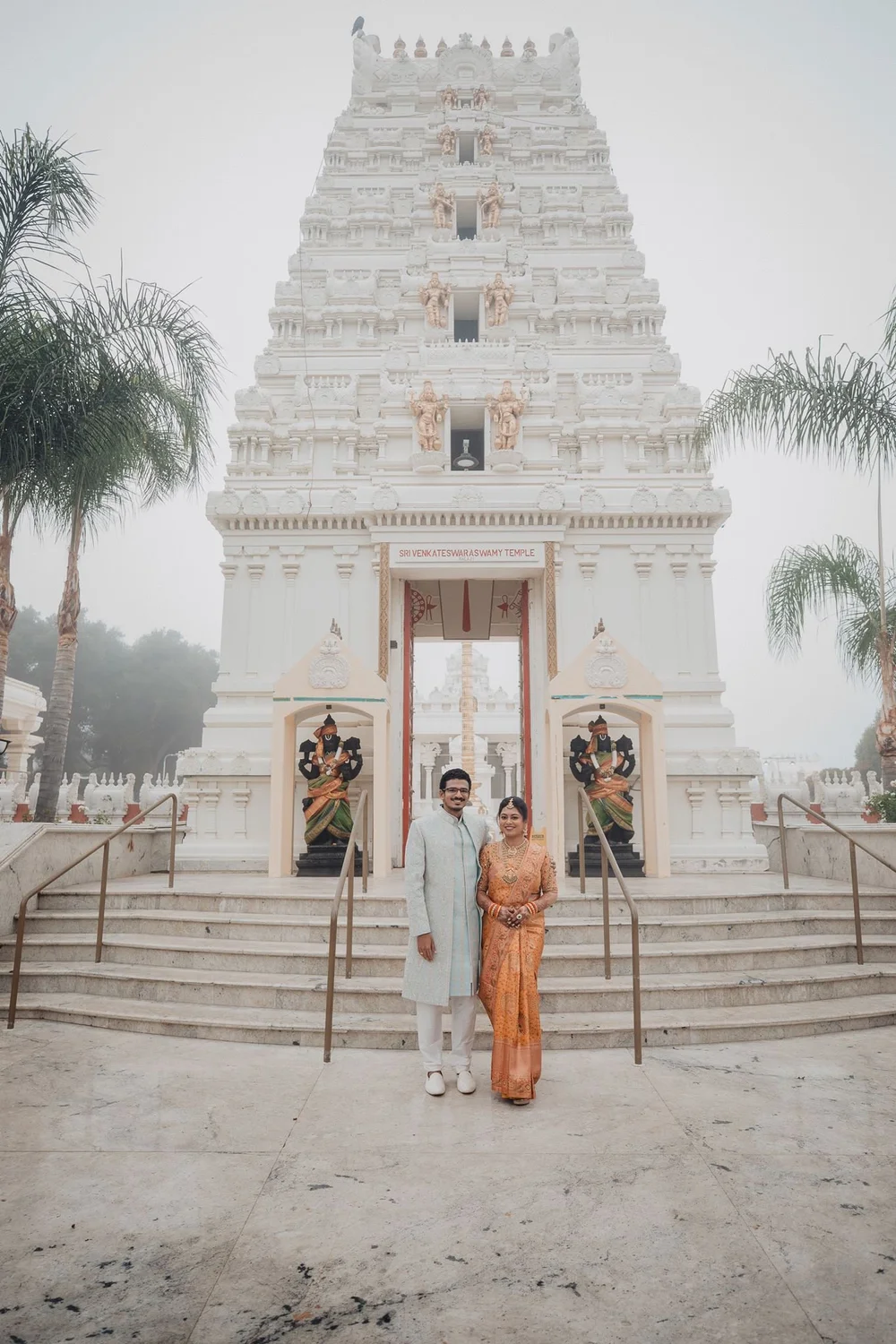
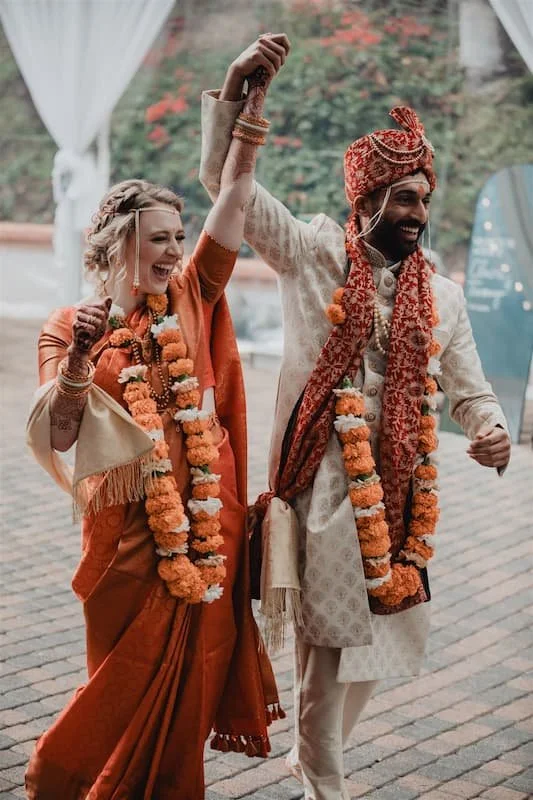
What a muhurat calendar does to a North American wedding
Hold the venue before the date is final
The gap between "we have a shortlist of muhurat dates" and "the pandit has confirmed one" is often three months. In February, May and November that is long enough to lose every good room in Los Angeles and Orange County. Hold two or three candidate dates with the venue and release the ones you do not use.
Expect a weekday, and price for it
Muhurat does not care about Saturdays. In 2028, only two of the eight June dates and neither of the two October dates fall on a weekend. The upside is real: a Thursday in an open month costs meaningfully less at most venues and gets you first choice of vendors.
The ceremony hour is not the event hour
A muhurat window can be twenty minutes long, at 5 a.m., on the day before the reception. We build coverage around the window rather than around a start time — which usually means a longer day, sometimes a split day, and occasionally a second photographer holding the ceremony while the first covers preparations.
Count the closed months as an opportunity
August, September and October are empty on the Hindu calendar in both years — and they are beautiful months in Southern California. If your family's tradition does not bind you to a muhurat, or if you are holding a civil ceremony separately, those months buy you the venues, the vendors and the rates that nobody else can reach.
Two sides, two calendars
An amanta and a purnimanta household will read the same lunar month differently. A Bengali panjika and a Gujarati panchang will publish different days. Get both families' sources named in writing early, then find the intersection — it is a much shorter conversation than discovering the mismatch after deposits.
Book flights against the blackout, not the date
Relatives travelling from India in a reopened month are competing with every other wedding in the country for the same seats. The week after Dev Uthani Ekadashi is the worst of the year. Ticket early or shift a day.
What couples ask us
Can I just pick a date off this page and book it?
No — and no published list should be used that way. The month windows here are stable, but the individual dates come from panchangs computed for Indian cities and the published lists disagree with each other by a wide margin. Use them to build a shortlist, then have your family's pandit confirm the day and the hour against both birth charts and for the city you are marrying in.
Why do two websites give completely different numbers of dates for the same year?
Three reasons. Some count an overnight window that runs past midnight as two dates and some as one. Some apply the yoga and karana filters strictly and some do not. And all of them are computed for a specific city — the muhurat is derived from local sunrise, so a window that exists in Delhi can be too short to qualify in Los Angeles.
Does a muhurat calculated for India work in California?
The date usually survives the move. The time frequently does not. Drik Panchang states plainly that its marriage timings are location-based and the city has to be set before the dates are read. Ask whoever prepares your muhurat to compute it for your wedding city — most will do it without being asked twice, and it takes them minutes.
Why are August, September and October empty in both years?
Chaturmas covers most of it: the four months from Devshayani Ekadashi to Devutthana Ekadashi, when no marriage rites are performed. In 2027 that is roughly 13 July to 9 November. On top of it, Venus is combust from late July into mid-September 2027, and Jupiter is combust across a stretch of autumn 2028 — so even the handful of days Chaturmas alone might have allowed are removed.
What is Shukra Asta and why did it take out our date?
Venus passing too close to the Sun to be visible at dawn or dusk. Classical texts hold that marriage rites are not performed while Venus or Jupiter is combust, and most panchangs add a buffer for the days just after the planet reappears (shishutva) and just before it sets (vriddhatva). These periods run for weeks and are unrelated to the rest of the calendar, so they routinely wipe out an otherwise perfect month.
Is there an extra lunar month in 2027 or 2028?
No. Neither year has an Adhik Maas — the last fell in 2026 and the next is expected in 2029. That is the main reason both years read as generous by comparison: May and June 2027, in particular, are completely uninterrupted.
Our families use different calendars and have given us different dates. What now?
Very common, and usually not a disagreement about astrology at all. North Indian families use the purnimanta lunar month and South Indian, Telugu and Kannada families use the amanta one, so the same month name covers different fortnights. Bengali families read one of two competing panjikas. Get each side's source named specifically — not "our pandit" but which panchang or panjika — and look for the overlap. The windows on this page are usually where it is.
We are Sikh. Do we need a muhurat?
Not under the Sikh Rehat Maryada, which discourages consulting horoscopes to fix a wedding date or time and places no restriction on when an Anand Karaj may be held. Many families still take a date from a pandit out of custom, which is a family decision rather than a religious requirement. The constraint that does apply is the Akal Takht ruling that the Guru Granth Sahib is not taken to resort or destination venues, so the Anand Karaj is held in a gurdwara.
What is an abujh muhurat?
A tithi considered auspicious in itself, so a wedding can be held on it without any calculation. Basant Panchami, Akshaya Tritiya, Devutthana Ekadashi and Vivah Panchami are the four most commonly used. They are a genuine escape hatch when families cannot agree — but they fall where they fall, often mid-week, and they are the most heavily booked days of the year.
Our muhurat is at 4:50 in the morning. Can you photograph that?
Yes — we have done it many times. A pre-dawn ceremony is a lighting problem rather than a scheduling one, and it is solved with equipment and a second shooter rather than by moving the ceremony. Tell us the window as soon as you have it and we will build the day around it, including a split-day structure if the muhurat and the reception fall on different dates.
Send us your dates. Even the ones that are not final.
We photograph and film South Asian weddings across Los Angeles, Orange County, San Diego and Las Vegas, and we hold candidate dates while families confirm a muhurat. Tell us the shortlist and we will tell you what is still open.